


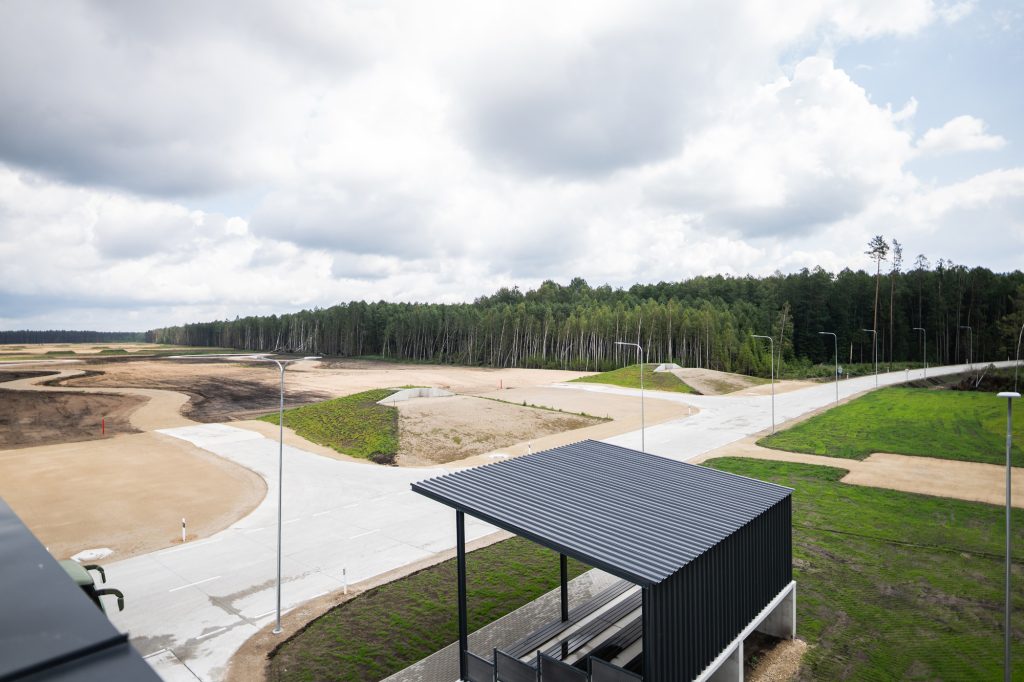
International practices and scientific research finds that military sites kickstart the economy in the region. The research conducted by U.S. and Latvian scientists demonstrate that defence sites not just support national security but also create thousands of new jobs and facilitate local business.
Ādaži: 2 700 new jobs in five years
The Ādaži Municipality, Latvia, has approx. 23 600 residents, similarly to Kėdainiai in Lithuania, It is an excellent illustration of the effect a military site can have on the economy. When Allied forces deployed in 2017, there were approx. 6600 jobs in the town. According to the data provide by the Central Bureau of Statistic of Latvia, the number was over 40% plus, the impressive 9300 jobs, over five years in 2022.
“Local manufacturers and service providers have identified the troops’ needs and offer catering, physical training and entertainment, beauty and more services,” states the Ministry of Defence of Latvia.
One army dollar spent makes four
The U.S. RAND think tank conducted a research in the State of Kansas with population of approx. 2.9 million, i.e. a number very near to Lithuania.
The United States Armed Forces was spending the annual USD 1.31 billion in Kansas. Combined with other military spending nationwide the financial activity in the state facilitated additional USD 3.92 billion economic activity in Kansas. The general positive economic impact of the U.S. military on the State of Kansas amounts to USD 5.23 billion.
According to the respected think tank experts, each dollar spent immediately in the State of Kansas is associable with additional economic activity worth nearly four times as much.
To put in other words, defence investment generate additional economic value: money of the Armed Forces circulate in local economy generating additional economic value and creating jobs.
The military creates additional jobs for civilians, according to U.S. researchers
The numbers do the speaking. There are 47 878 military job positions in Kansas. Combined with national-level military financial activity, this spending supports 41 033 extra private sector jobs in shops, construction companies and services.
The evident chain reaction demonstrates the effect of the military on a thriving region. A service member’s dinner at a local restaurant requires purchasing from local food suppliers and wages to restaurant staff, which continues to be spent in local shops and the money thus circulates in the community.
Stability assurance for the region
“Every military site brings economic benefit to the communities, frequently employing thousands and spending millions on constructions and purchasing from local businesses,” explains TJ Costello, senior economist in the Data Analysis section at the Texas Comptroller of Public Accounts.
Unlike factories that may close down, or companies that may move out, military sites are to stay typically for decades diving economic security to the region.
“Men and women who are employed or serve at military sites shape the backbone of the communities. They support countless businesses and help create new job across the whole state,” claims TJ Costello.
Lithuania’s experience supports the international practice
There is no sufficient research on the benefits of military sites in Lithuania. However, material of the State Data Agency of 2015–2023 show that the counties that house the Lithuanian Armed Forces Training Areas have the average of 25% GDP advantage per person as compared to military installation-free counties.
The analysis excludes the county of Vilnius as affected by the status of capital and almost half of the economy of Lithuania in it. The county of Kaunas housing the Gaižiūnai and Rokai Training Areas, the county of Marijampolė which accommodates the Kazlų Rūda Training Area, and the county of Klaipėda housing the Kairiai and the Pagudonė Training Areas leads by triple the GDP as compared to the counties without military sites.
In 2023 the counties containing military sites hit EUR 20.8 thousand of GDP per person, while the counties without military installations stood at EUR 16.2 thousand.


