


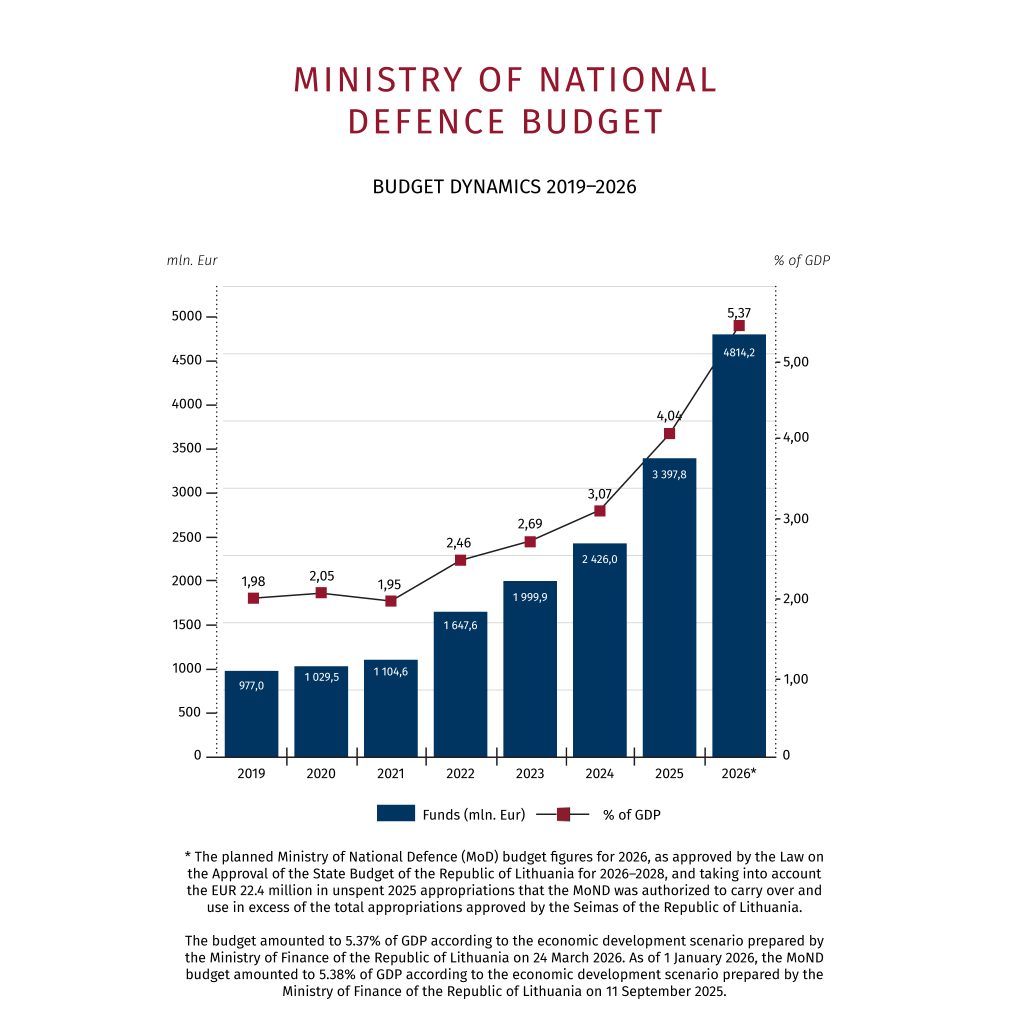
2025
On December 19, 2024, the Seimas of the Republic of Lithuania passed the Law on the Approval of the 2025–2027 State Budget and Municipal Budgets. At the beginning of 2025, the appropriations approved for the Ministry of National Defence (MoD) amounted to EUR 2,508.3 million. Of this total, EUR 240.2 million were funds from the State Defence Fund and EUR 20.7 million were funds allocated to the Lithuanian Riflemen’s Union.
Over the course of 2025, the MoD was allocated an additional EUR 928.9 million. These funds are dedicated to:
- Acquiring weaponry, equipment, and ammunition necessary for the development of a division-level military unit capability.
- Developing the military infrastructure required for this unit.
- Support for Ukraine.
- Implementing other priority National Defence System projects related to the development of defense capabilities and other MoD requirements.
Taking into account the unused appropriations from the previous year that the MoD could spend within the limits of its bestowed rights (outside the overall amounts approved by the Seimas), the total appropriations spent by the MoD in 2025 amounted to EUR 3,397.8 million, or 4.04% of GDP.
State Defence Fund (SDF) resources were utilized in accordance with the Law on the State Defence Fund. The allocation of these funds was as follows:
- 56.1% for the acquisition of weaponry and military equipment.
- 33.7% for the development of military infrastructure.
- 10.0% for the procurement of military supplies.
- 0.2% for the implementation of the program specified in the Law on Crisis Management and Civil Protection, aimed at strengthening and developing civil protection.
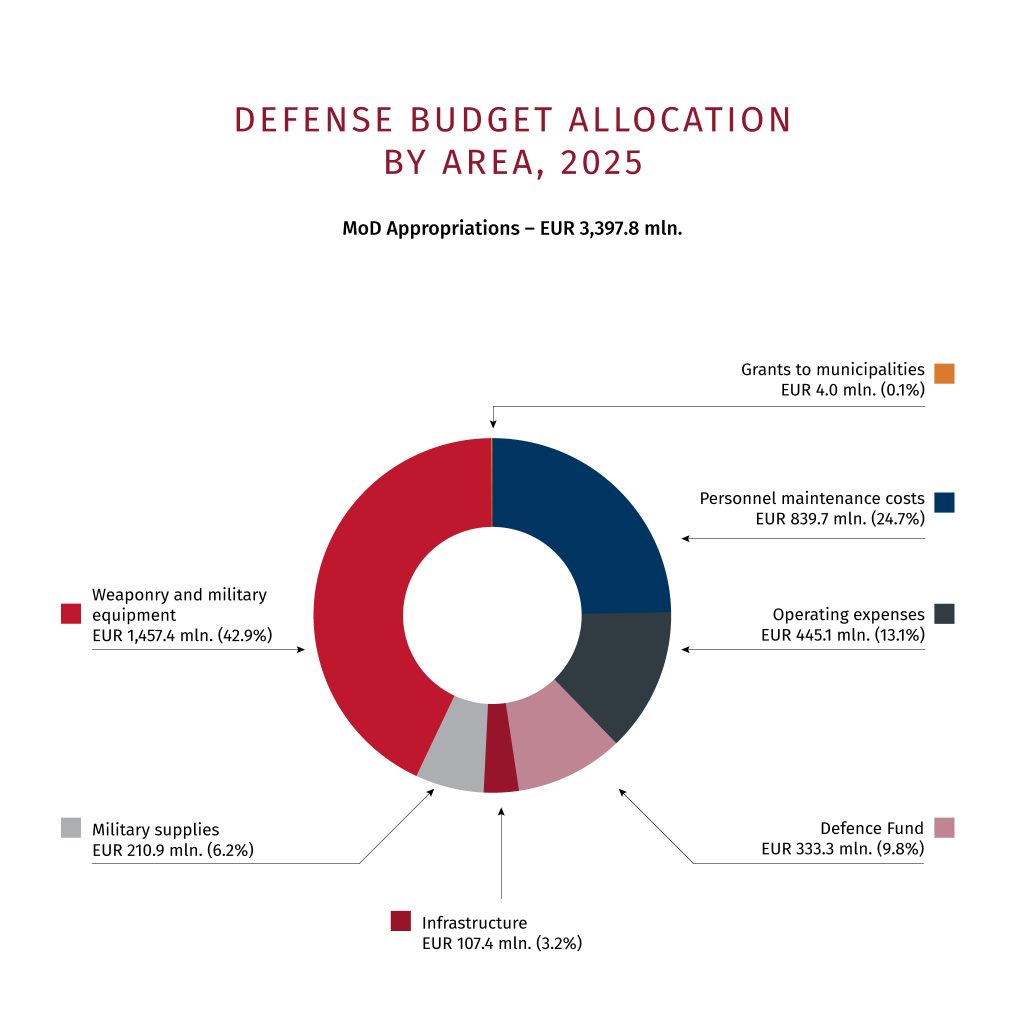
2026
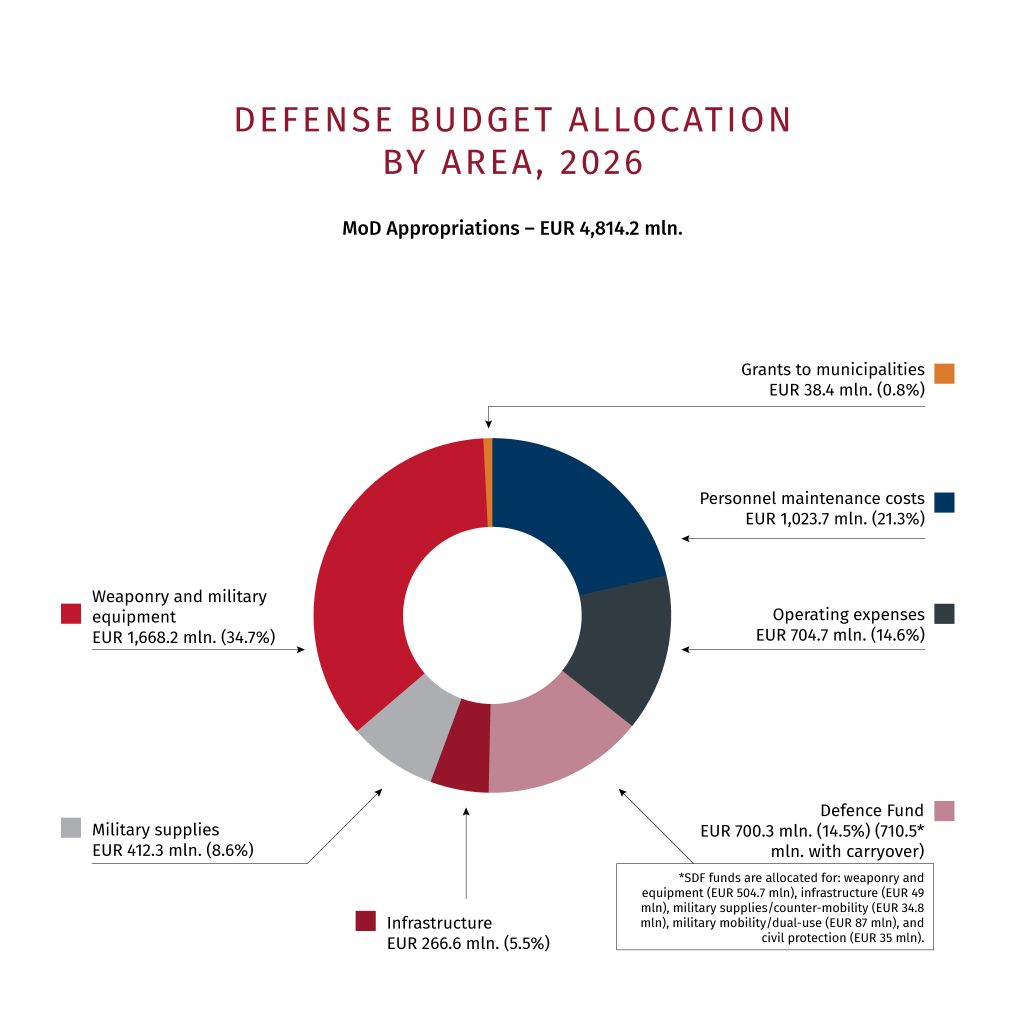
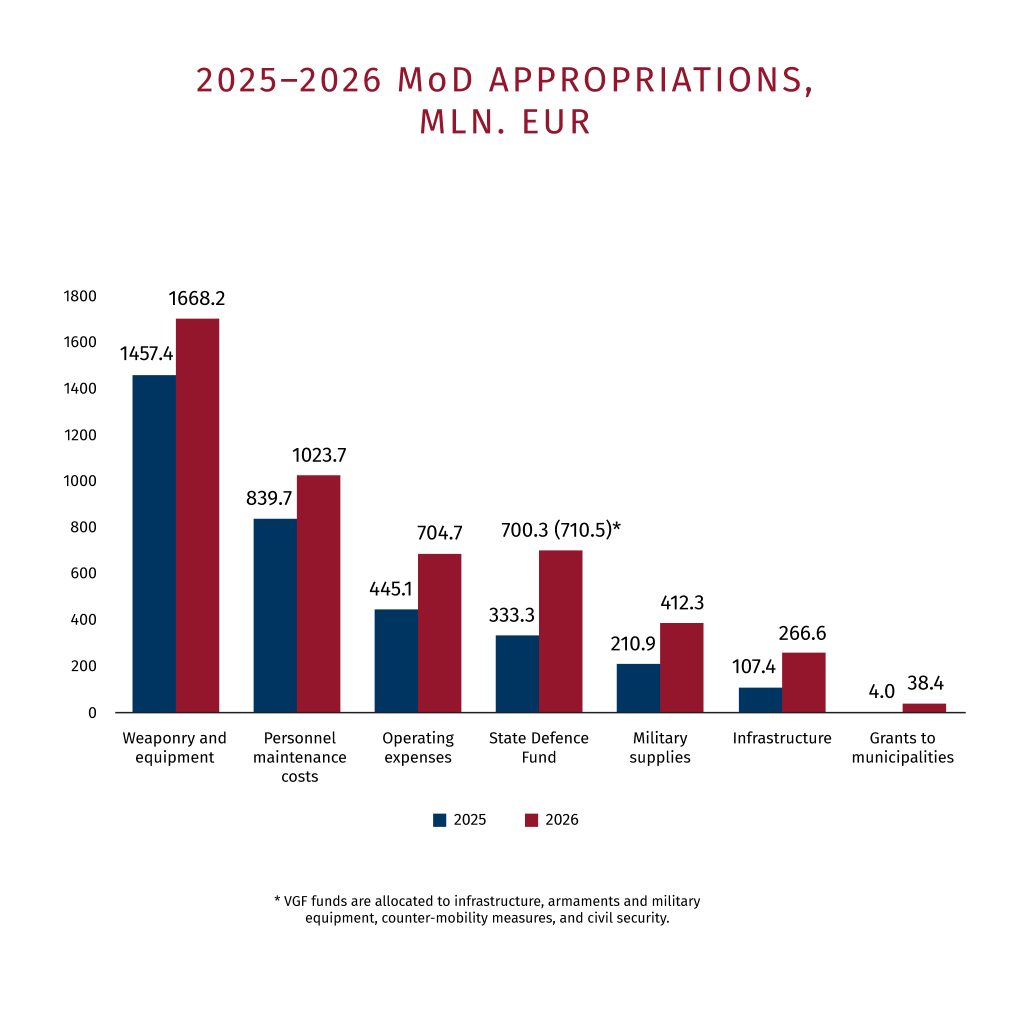
The Law on the Approval of the 2026–2028 State Budget of the Republic of Lithuania stipulates that MoD appropriations for 2026 will amount to EUR 4,791.9 million, which includes EUR 700.3 million from the State Defence Fund (EUR 710.5 million including the carryover balance from 2025). Compared to 2025, the MoD budget is increasing by 41%, marking the largest budget in the history of independent Lithuania and ranking first among NATO members.
State budget appropriations, taking into account the 2025 unused appropriations permitted to be used under the rights granted to the MoD above the total amounts of appropriations approved by the Seimas of the Republic of Lithuania, amount to EUR 4,814.2 million or 5.37% of GDP in 2026.
The MoD budget is structured according to the main priorities of the National Defence System: funding is provided for the development of the National Division capability, reception of the NATO brigade, airspace surveillance and defense measures (including integrated air defense according to the State Defence Council decision), etc.
In 2026, funding also increases for other critical areas of responsibility: more funds are allocated to personnel maintenance (expansion of personnel, wages, etc.), support for Ukraine (0.25% of GDP), Host Nation Support for allied contingents in Lithuania (USA, Germany, and other countries), and maintenance costs are increasing for newly received technologically advanced equipment, weaponry, as well as new infrastructure.
Significantly, the budget focuses on strengthening preparation for Total Defence. More funds are allocated to civil protection, strengthening the mobilization function, and developing municipal social and engineering infrastructure, while funding levels for military mobility and dual-use infrastructure projects are essentially maintained, etc.
The Lithuanian Riflemen’s Union will receive EUR 24.2 million in 2026 for its activities and equipment, which is approximately 30% more than in 2025.
KEY PRIORITIES IN THE MOD BUDGET 2026
In 2026, hundreds of weaponry and equipment acquisition projects vital to the Lithuanian Armed Forces (LITHAF) are underway, the implementation of which will significantly strengthen LITHAF’s combat power, troop protection, land maneuver, airspace defense, intelligence, and logistical capabilities. In the area of military modernization, priority is given to air defense and the development of the First National Infantry Division.
The following major acquisition projects are being implemented in 2026:
- drone detection and anti-drone defense systems (according to the State Defence Council decision);
- mobile medium-range radars;
- PIORUN short-range air defense systems;
- MSHORAD mobile short-range air defense systems (Phases I–III);
- NASAMS medium-range air defense systems (Phases II and III);
- tanks;
- infantry fighting vehicles (Phase I completion);
- launch of tracked infantry fighting vehicle acquisition;
- reactive salvo systems (Phases I–II);
- JLTV armored vehicles (Phase I–II completion);
- 155 mm howitzers (Phase B / Phase II);
- anti-tank weaponry (JAVELIN, SPIKE, CG);
- artillery radars;
- utility helicopter platforms;
- mine counter-measures, search and rescue (MCM and SAREX) ship;
- electronic warfare equipment;
- command and control, intelligence, surveillance, and target acquisition systems.
LITHAF members and the reserve are also being provided with individual weaponry, gear, and individual CBRN protection equipment. The weaponry acquired under these projects will reach LITHAF units over the coming years. Weaponry acquisition projects are coordinated alongside ammunition procurements.
The development of critical LITHAF infrastructure continues, with priority placed on improving conditions for host nation support, military training, storage and maintenance of newly acquired weaponry, and ammunition storage. The greatest attention is focused on creating the infrastructure for the German brigade; main LITHAF training grounds in Rūdninkai, Pabradė, Rukla, Kairiai, and Kapčiamiestis are being developed; Air Force Base infrastructure is being upgraded; new barracks are being built and existing ones reconstructed across various LITHAF units; ammunition storage warehouses are being constructed, and the infrastructure for the First Division is being developed.re.


