


The 2026 national defense budget will reach a record-breaking 5.37% of GDP. Compared to 2025, the Ministry of National Defense (MoD) budget is increasing by 41%, making it the largest in the history of independent Lithuania and placing it first among NATO members.
The 2026 MoD budget has been compiled in accordance with the main priorities of the National Defense System—allocating the necessary funding for the development of national division capabilities, hosting the NATO brigade, strengthening air defense, etc. It is important to note that in 2026, more funds are allocated for personnel maintenance, support for Ukraine (0.25% of GDP), host nation support for allied contingents in Lithuania (US, Germany, and other countries), and expenses are increasing for the maintenance of newly acquired technologically advanced machinery, equipment, weaponry, as well as new infrastructure.
Funds within the MoD budget are growing significantly to strengthen readiness for total defense. Provision is made to allocate more funds for civil protection, strengthening the mobilization function, developing the social and engineering infrastructure of municipalities, while the level of funding for military mobility and dual-use infrastructure projects is essentially maintained.
It is important to note that the increased national defense funding provides the conditions for faster modernization of the Lithuanian Armed Forces and the reinforcement of essential defensive capabilities. This is influenced by the changed security situation in the region, lessons learned from russia’s war against Ukraine, and similar factors. In the field of military modernization, priority is given to air defense and the development of the First National Infantry Division. Therefore, land capabilities, indirect fire power, air defense, logistics, intelligence, secure communications, cyber security, unmanned systems, and counter-drone capabilities are being consistently strengthened.
At the same time, great attention is paid to the accumulation of ammunition and strategic reserves, as well as strengthening the national defense industry. Contracts with Lithuanian manufacturers for anti-tank mines, FPV drone charges, and other equipment allow for shorter supply chains and increase state resilience.
NATO collective defense commitments are one of the fundamental pillars of Lithuania’s security architecture. The presence of allies in Lithuania ensures the implementation of these commitments. Special attention is paid to the permanent deployment of Germany’s 45th Armored Brigade “Lithuania”. To this end, the Rūdninkai military campus, training infrastructure, living and service conditions for soldiers, and equipment storage and maintenance capabilities are being developed. The transfer of the NATO Multinational Battle Group to the command of the German brigade marks an important milestone in the implementation of this historic decision.
MAJOR PROJECTS
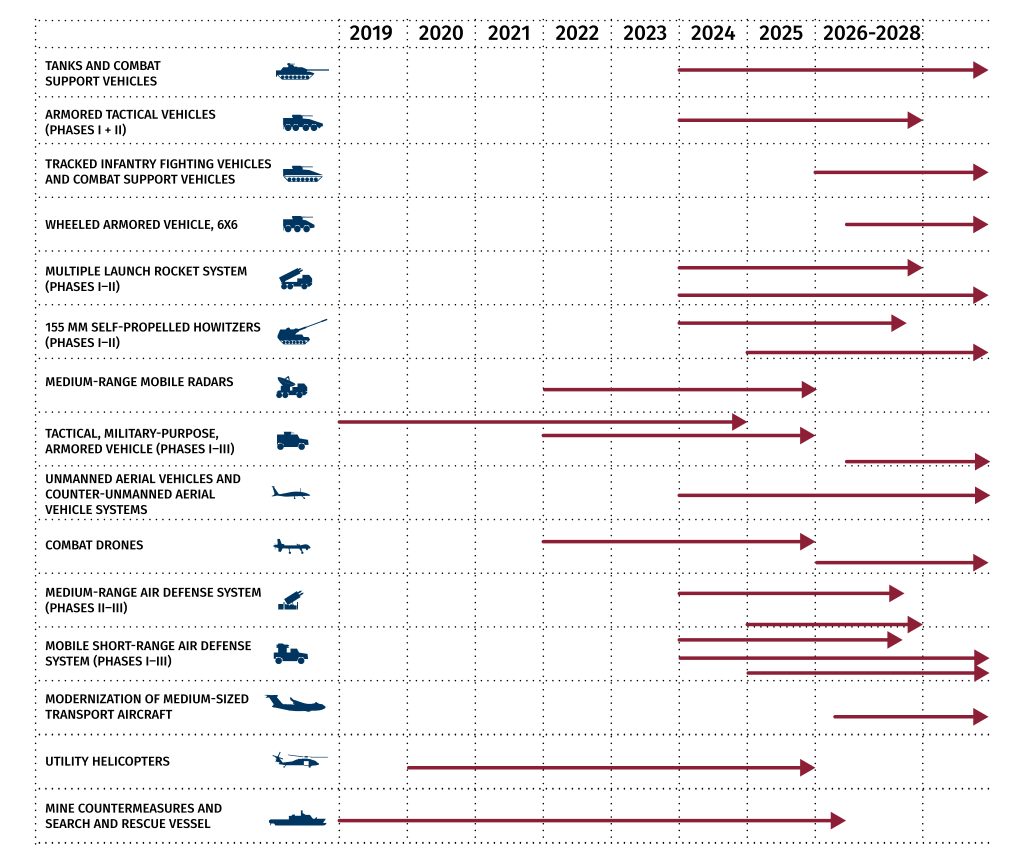
In developing the capabilities of the Lithuanian Armed Forces, the largest investments are directed toward the acquisition of tanks, wheeled infantry fighting vehicles, JLTV armored tactical vehicles, CAESAR 155 mm self-propelled howitzers, HIMARS rocket artillery systems, NASAMS medium-range air defense systems, short- and close-range air defense systems, radars, anti-tank weaponry, unmanned systems, ammunition, and other supplies. A decision has also been made regarding the acquisition of new PATRIA wheeled armored vehicles.
The strengthening of HIMARS capabilities continues with the acquisition of a second battery, which will increase the Lithuanian Armed Forces’ ability to operate at long ranges and destroy high-value targets. In the field of air defense, investments are being made in NASAMS, RBS-70 “Bolide” missiles, MSHORAD systems, and “Giraffe” 1X radars, which will strengthen protection against aerial threats, including unmanned aerial vehicles.
To strengthen the maneuverability and mobility of the Land Forces, heavy equipment and supporting capabilities are being acquired, including LEOPARD 2 A8 LEGUAN bridge-layers. Acquisitions also continue for UH-60 “Black Hawk” helicopters, “Carl-Gustaf M4” grenade launchers, anti-tank systems, as well as logistical, medical, engineering, and special-purpose equipment.
Modernization is complemented by the expansion of military infrastructure—developing training grounds, military training areas, storage, repair, accommodation, and host-nation support facilities. These projects create the conditions for the readiness of the Lithuanian Armed Forces, the reception of allies, and the strengthening of security on NATO’s eastern flank.


