


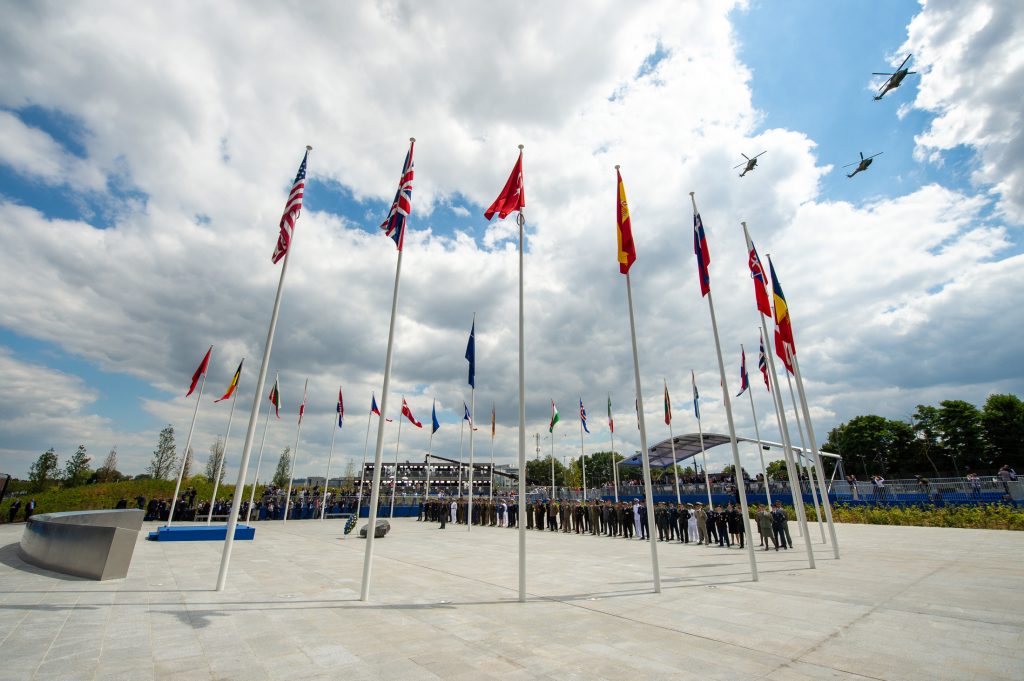
NATO membership and relations with the Allies
Lithuania’s defence is an integral part of NATO’s collective defence, therefore maintaining and strengthening the security measures of the United States (hereinafter referred to as the United States) and NATO in the Baltic States and Poland remains one of the main preconditions for reliable deterrence and defence:
- The most important goal of cooperation with the United States is the deployment of a US rotating battalion in Lithuania, ensuring the necessary support from the host country. The military interoperability of the Lithuanian Armed Forces with the US forces must be further improved, intensive co-operation in synchronizing defence planning, organizing and participating in joint exercises must be continued, seeking US support for the development of the Lithuanian Armed Forces military capabilities, and participating in international operations. Cooperation with US analytical and research centers needs to be continued to reflect regional security concerns in US foreign and security policy;
- In order to continue the German leadership of the NATO enhanced Forward Presence Battalion Battle Group and the long-term presence in Lithuania, joint military infrastructure projects must be further developed, joint training of the LSC and the Front Forces Battalion must be organized, and joint capability development must be continued. It is necessary to strengthen cooperation with German analytical centers so that Lithuania’s security interests will be at the top of the German political agenda;
- Cooperation with Poland must continue to focus on the format of the Council of Defence Ministers and on cooperation in specific areas of practical importance;
- Cooperation in the format of the Baltic States must be focused on the development of joint regional capabilities, cooperation between the eight Nordic and Baltic countries (NB8) must be continued, and strong political and practical attention must be paid to the development of the Joint Expeditionary Forces;
- Lithuania’s interest in NATO is to continue deterrence measures in the region and strengthen collective defence by incorporating key deterrence and collective defence provisions into NATO’s renewed Strategic Concept, developing NATO defence plans and their compatibility with US and national defence plans, and adapting NATO’s command and force structure rapid reinforcement by fire and force, overcoming the ability to restrict access and blockade in the region, with a special focus on air defence in the region;
- In response to the security challenges facing Lithuania and its allies, it will continue to participate in international operations, prioritizing NATO- and US-led international operations and the national military training operation in Ukraine, as well as contributing to EU-led and UN-led international operations and missions.
EU membership
Active participation in the development and implementation of the EU’s Common Security and Defence Policy (CSDP), in particular in the framework of the Permanent Structured Cooperation (PESCO) format, remains an important complementary tool for security assurance, capacity building and practical response to cyber and hybrid threats:
- By implementing Lithuania’s leadership of the international PESCO Cyber Rapid Response Teams and mutual assistance in the field of cybersecurity project, the full operational capability of these teams must be achieved within the next year. This includes being ready to provide assistance to the participating states in the event of cyber incidents, supporting CSDP missions and operations, providing support to EU institutions in responding to cyber threats, and contributing to the improvement of the EU’s collective response to cybersecurity incidents.
- Lithuania must continue to participate in EU military mobility improvement initiatives to facilitate the arrival of allied forces in the Baltic Sea region, develop dual-use infrastructure adapted for military mobility, and simplify and synchronize military movement procedures applied by EU states.
- Support should be provided to Lithuanian companies participating in defense capability development and research projects funded by the European Defence Fund.
Eastern Partners
The role of the Ministry of National Defence in maintaining a safe and stable Eastern Neighborhood and improving Lithuania’s security environment is crucial:
- The focus must be on the reform of the armed forces and the defence system in Ukraine and Sakartvelo, providing political, expert, material and financial support for the continuation of the national training operation in Ukraine;
- Political support must be provided to the EU’s associated partners in initiating security and defence cooperation projects with Ukraine;
- There must be involvement in joint exercises and training with Ukrainian and Sakartvelo soldiers in Lithuania, Ukraine, Sakartvelo;
- Minimum defence contacts with Belarus must be maintained in order to increase transparency and ensure reciprocity.


