


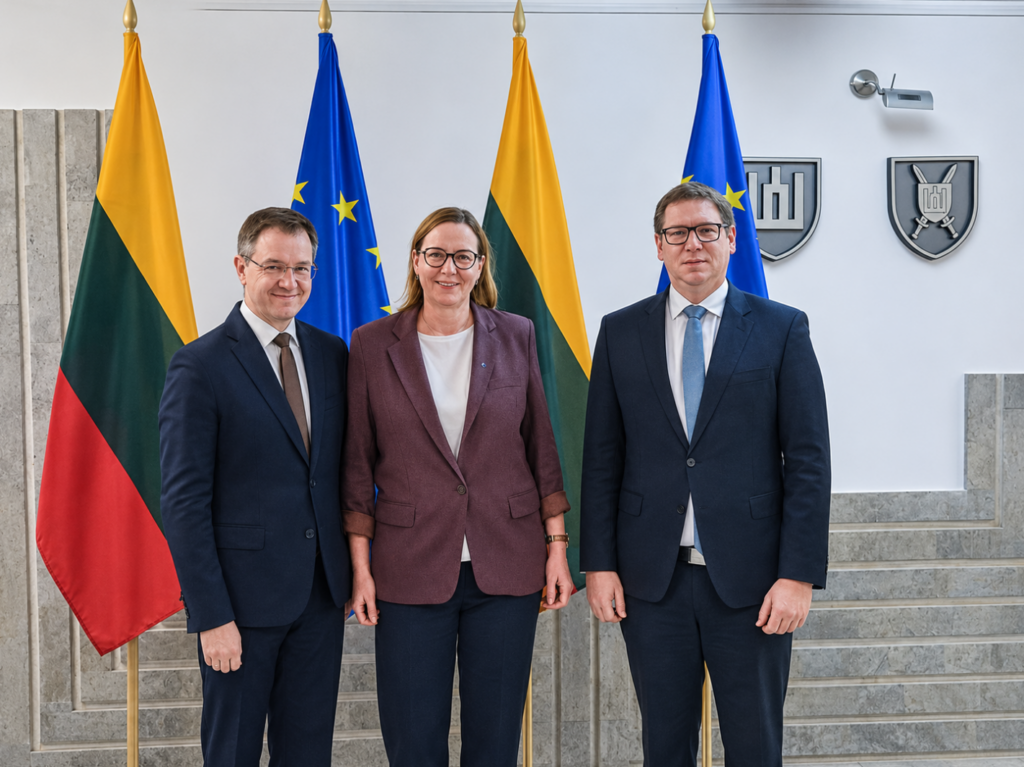
Today, Vice Minister of National Defence Karolis Aleksa met with Secretary General of the European Commission (EC) Ilze Juhansone and Head of Cabinet to the EC President Björn Seibert. The main highlights of the meeting concerned the security and defence priorities for the upcoming period of Lithuania’s presidency of the Council of the EU, current issues on the European security and defence agenda, defence financing prospects, European security and defence initiatives, and the implementation of Lithuania’s national Small UAV Defence Project.
During the EU Presidency starting on January 1, 2027, Lithuania will advance European defence readiness, particularly focusing on the Eastern Flank, as well as strengthening the European defence industry, while securing a sustained military support for Ukraine, improving military mobility, and cyber security. The meeting with EC officials addressed the prospects of delivering on the listed priorities and further interinstitutional collaboration.
“During Lithuania’s Presidency, we will work to give momentum to the EU security and defence initiatives already underway and to ensure that EU financial and legislative instruments serve as effective enablers for actual military capabilities. We put stronger European defence readiness at the top of our agenda, while making sure the developed EU capabilities align with NATO capability targets,” said Vice Minister K. Aleksa.
One of the most important aspects of Lithuania’s upcoming EU Presidency will be the negotiations on the Multiannual Financial Framework (MFF) for 2028–2034. Lithuania will work to secure maximum financing for European security and defence, military mobility and reinforcement of defence industry, in the next EU budget. According to Vice Minister, it is crucial to match EU-level investment with the real defence needs of Member States, as well as coordination with NATO targets in the same area.
Another theme discussed concerned further enhancement of air defence. Lithuania is particularly focused on the area considering the growing threat posed by UAVs and the need to improve the European capability to protect its airspace. The Small UAV Defence Project is one of the practical steps aimed at increasing defence readiness on the Eastern Flank.
“The war in Ukraine has demonstrated the importance of early detection and neutralization of air threats, especially UAVs, in modern defence. Therefore, European funds need to target the exact capabilities critical to our security right now. Small UAV Defence Project development is an essential part of this effort, while joint European solutions can help deploy the right technology and integrate it with the overall defence system,” Vice Minister underscored.
When discussing support for Ukraine, Karolis Aleksa underscored the need to secure financing for long-term military assistance, continue European defence initiatives, and create more favorable conditions for integrating Ukraine’s defence industry into the European technological and industrial base. Joint defence industry projects with Ukraine could increase production volumes, accelerate the integration of innovations, and strengthen the military capabilities of Europe as a whole.
“The success of Ukraine’s self-defence has direct implications for the security of Europe. Therefore, it is vital to secure sufficient and sustained military support that aligns with Ukraine’s actual needs. We must integrate the Ukrainian defence industry into the European defence industrial base as soon as possible. Ukraine’s combat experience and battle-tested technology are invaluable for strengthening Europe’s overall defence potential,” said K. Aleksa.
The meeting officials underlined the importance of close cooperation between Lithuania and the European Commission for the smooth delivery of Presidency priorities, consensus among Member States, and achieving progress on key European security and defence objectives.
Lithuania will take over the rotating Presidency of the Council of the EU from Ireland. Throughout the tenure, Lithuania will coordinate the work of the Council, broker consensus among Member States on key issues, and conduct negotiations with the European Parliament and the European Commission on European legislative initiatives.


