


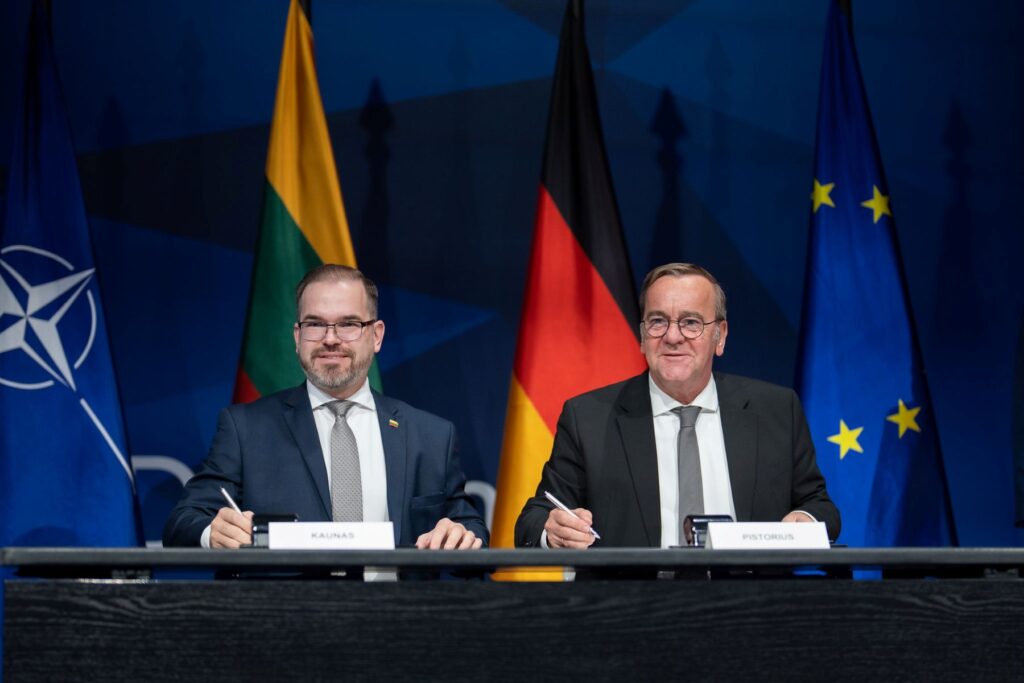
Minister of National Defence Robertas Kaunas and Germany’s Federal Minister of Defence Boris Pistorius signed a Declaration on Strategic Defence Cooperation at the Munich Security Conference, marking a new stage of strategic partnership between the two countries and setting long-term directions for further cooperation.
“We have signed a historic agreement which expands our cooperation with Germany virtually across all security sectors. The German Brigade remains the axis of our cooperation, while the practical meaning of the Declaration translates to more exercises reflective of contemporary security concerns on the ground in Lithuania, more joint training, and faster military mobility procedures. We see air defence and protection against UAVs as key priorities,” says Minister of National Defence R. Kaunas.
Germany is among Lithuania’s key strategic partners in defence; its decision to station a brigade in Lithuania stands out as an unprecedented contribution to the defence of NATO’s Eastern Flank. The new declaration extends the limits of cooperation, paving the way for an even closer integration of both countries’ Armed Forces, increasing their interoperability and readiness to act together.
Closer military integration and better interoperability in defence capability development
Cooperation is planned to expand in the areas of defence capability development and strengthening defence industry partnerships. Future acquisitions are planned with interoperable or interchangeable solutions and EU financing in mind.
Cooperation will also be advanced through joint experiments which facilitate the integration of new technology, alongside closer mutual efforts in logistics, military mobility, and medical support.
Another objective is a tighter partnership between the German Homeland Defence and the Lithuanian National Defence Volunteer Force, as well as the Lithuanian Riflemen’s Union. Regular exchanges of experience and expertise have been mapped out.
Intensified cooperation is planned in the areas of military reconnaissance, electronic warfare, military and dual-use infrastructure, space security and defence, counter-cyber and hybrid threats, strategic communications, and countering information attacks.
A separate Action Plan will be issued to implement the political directions set out in the Declaration.
Stationing the German Brigade – mutual commitment in action
Germany took a historic decision to deploy a brigade permanently in Lithuania; in turn, Lithuania provides the required infrastructure.
“There were numerous recognitions of our exemplary cooperation and speed voiced during the meetings and from the stage of the Conference to the Ministry of National Defence. Phase I of the Rūdninkai Military Campus is nearing completion ahead of schedule, Phase II is gaining pace, and we have confirmed to our German partners the full completion of all the needed infrastructure for the Brigade by the end of 2027. Moreover, this is the first time in history that Germany has co-hosted the Berlin Security Conference together with Lithuania, thus demonstrating that we are appreciated and respected in the international arena,” states Minister R. Kaunas.
The development of the infrastructure for stationing the German Brigade at Rūdninkai is part of a wider agreement between Lithuania and Germany on the various aspects of the permanent deployment. The Brigade is planned to reach Full Operational Capability on the ground by the end of 2027, with 5,000 German military and civilian personnel working and serving in Lithuania.
The strategic partnership between Germany and Lithuania enhances both countries’ defensive capabilities, contributes to a more reliable defence of the Eastern Flank, and demonstrates in practice the tight Allied cooperation increasing European security.


