


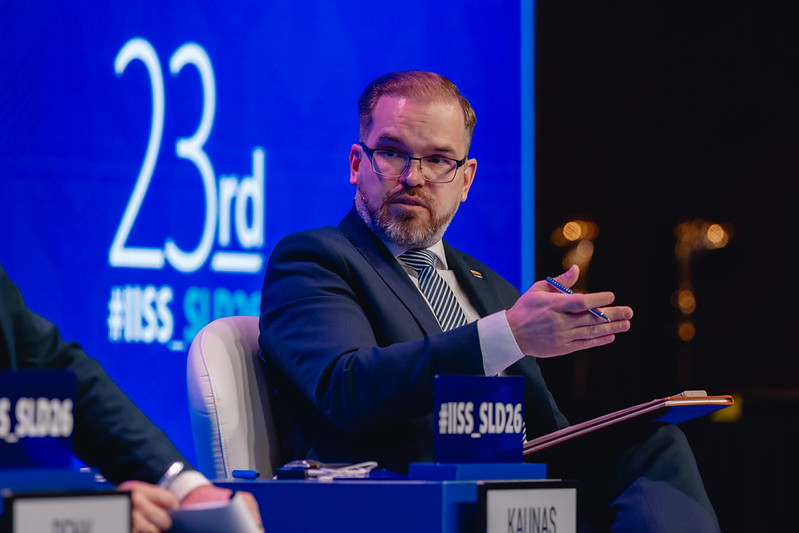
On May 29–31 Minister of National Defence Robertas Kaunas attended the major security and defence forum of Asia, Shangri-La Dialogue, in Singapore. Minister spoke at the Second Plenary Session on “Priorities within Asia’s Shifting Strategic Landscape.”
Addressing the participants, Minister underscored that modern threats transgress region boundaries making collaboration against the aggressor a strategic imperative.
“Hybrid pressure, balancing the verge of armed attack and giving counterfeit excuses, is not a challenges only Europe faces. The same logic and structure with different tools is observed in the region of Asia. Smaller nations should not have to face these threats alone,” said Minster R. Kaunas.
He pointed out that Lithuania and the Indo-Pacific partners were bound by adherence to the same principles: rules-based order, sovereignty regardless of the country’s size, freedom of navigation, every country’s right to choose its partners independently.
“Lithuania understands well that we need to invest in our own security, that is why Lithuania’s defence budget this year has reached 5.38% of GDP. However, defence always rests on two pillars: homework done and cooperation with Allies, partners, the like-minded. We enjoy excellent relations with Ukraine, we are developing uncrewed aerial systems, electronic warfare equipment together. I have met with defence sector companies while here, in Singapore, we have addressed the need to develop technology together, establish reliable supply chains, strengthen research and development. This is the way in which small countries are able to joint defence ecosystems and security processes too. I am confident that Lithuania is able to build an exceptionally robust mechanism of deterrence with our partners,” Minister of National Defence underscored at the Shangri-la Dialogue.
When discussing partnerships, Minister R. Kaunas essentially seconded what U.S. Secretary of War Pete Hegseth said in the plenary Session a little earlier: “We need to form a team of strong, independent countries who are able to defend their sovereignty and provide collective security together.”
While at the security forum, Minister of National Defence also met bilaterally with Minister of Defence of Singapore Chan Chun Sing.
He also spoke to U.S. Secretary of War Pete Hegseth, leadership of the United States Indo-Pacific Command (INDOPACOM), Minister of defence of Australia Richard Marles, Minister of Defence of Japan Shinjiro Koizumi, European Ministers, and gave interviews to global media, on the margins of the Shangri-la Dialogue.
Regional security was in the focus, including critical undersea infrastructure security and hybrid threats. They also discussed bilateral cooperation, cyber security, strengthening defence industry and assistance to Ukraine.
Also, Minister R. Kaunas invited Singapore’s defence contractor ST Engineering to test the advanced counter-drone system they develop in Lithuania.
Lithuania, together with 16 more countries, including the United Kingdom, Singapore, Australia, Japan, France, and the Nordic countries, declared the Guiding Principles for Underwater Infrastructure Defence Exchanges (GUIDE) Framework at the event. The agreement maps out guidelines for cooperation among defence institutions to protect strategic undersea cables and pipelines. The Framework Partners underscored that geographical barriers were no obstacle for a flexible response tom hybrid threats in new areas of defence.
The Shangri-La Dialogue is a top level event that brings together Defence Ministers and security experts from across the Indo-Pacific, Europe, North and South Americas,and other regions of the world, to address global security trends and challenges.
Lithuania is strengthening cooperation with the Indo-Pacific partners. Last year, the Strategy for Security and Defence Engagement in Indo-Pacific Region was developed. Lithuania plans to devote more attention in this area at the EU level when it holds the Presidency of the Council of the EU in 2027.
Photo credit: Shangri-La Dialogue organising team


