


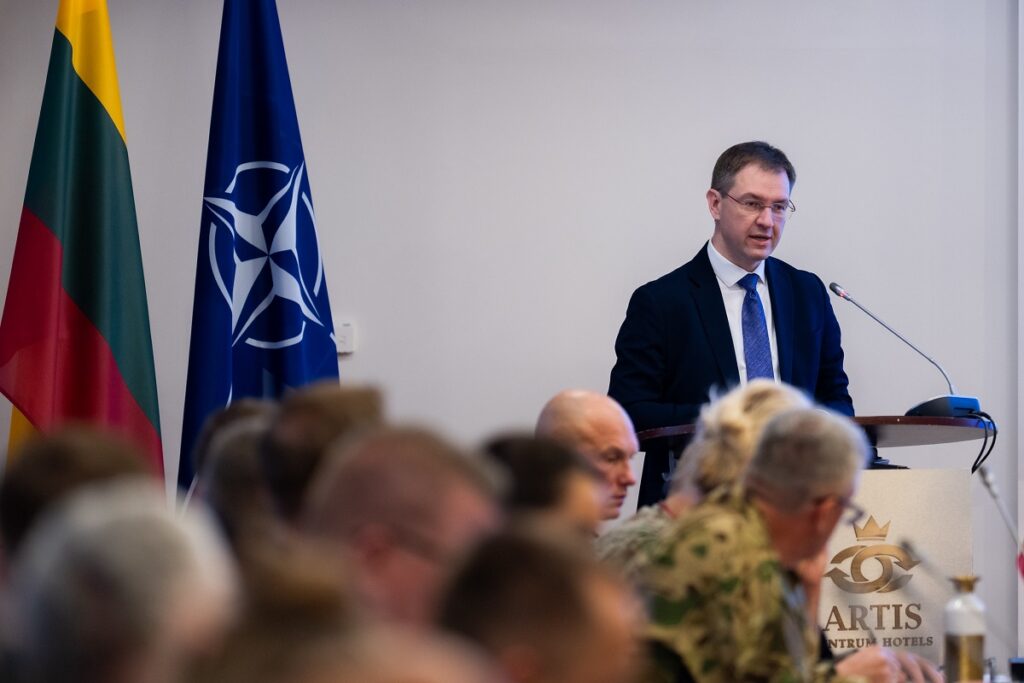
The NATO Committee on Reserves (NCR) convened for the first time in Lithuania bringing together Allied and NATO partner representatives to discuss strengthening reserve forces, improving their readiness and integration in the collective defence plans. Lithuanian representatives at the event debriefed the Allies and partners on the national reserve system reform which focused on meeting personnel needs of the growing Lithuanian Armed Forces, as well as its readiness for national defence.
Presenting Lithuania’s security situation, defence needs and the plans of the Lithuanian Armed Forces’ personnel growth, Vice Minister of National Defence Karolis Aleksa underscored that strengthening the reserve was an inseparable part of the NATO readiness for collective defence.
“Russia’s armed aggression against Ukraine and the growing threat on the Eastern Flank require an in-depth approach to strengthening our readiness for defence. We invest in advanced weaponry, the formation of the National Division is underway, the process of stationing the German Brigade in Lithuania is in progress; however, the one foundation that underpins all of the mentioned capabilities is personnel readiness. The reserve needs to be competent to be integrated into the regular force and to take charge of their designated tasks from day one. Therefore, Lithuania consistently increases the number of reserve personnel, while stepping up their readiness training and integration in the Armed Forces defence plans,” said Vice Minister K. Aleksa.
Lithuania is consistently building a more significant Armed Forces reserve by increasing its capabilities, improving personnel training and their readiness to ensure defence. Development of the reserve is coordinated with the development plans of the Lithuanian Armed Forces to ensure that the trained reserve personnel is integrated in military units properly and is able to add up to the regular force expeditiously. Skill refreshment and readiness enhancement of the reserve personnel is taken very seriously.
Vice Minister also underlined the importance of competences in the civilian sector for the military. Reservists bring in medical, engineering, logistics, technology, communications and other competencies to the Armed Forces increasing its capacity for complex tasks and improving resilience of the state.
The NATO Committee on Reserves (NCR) is a standing body that advises the NATO Military Committee (NMC) that provides recommendations on reserve force policies. The meeting in Vilnius this week was co-organized by the Ministry of National Defence, the Lithuanian Armed Forces and the Secretariat of the NATO Committee on Reserves.
The seminar was attended by approx. 50 representatives of NATO Commands, Allies, and partners, including Ukraine, Australia and Switzerland. They shared national experience discussed the challenges and solutions of developing reserve forces that might help enhance the Allied mobilization and deployment of reserve forces in case of crisis or war.


