


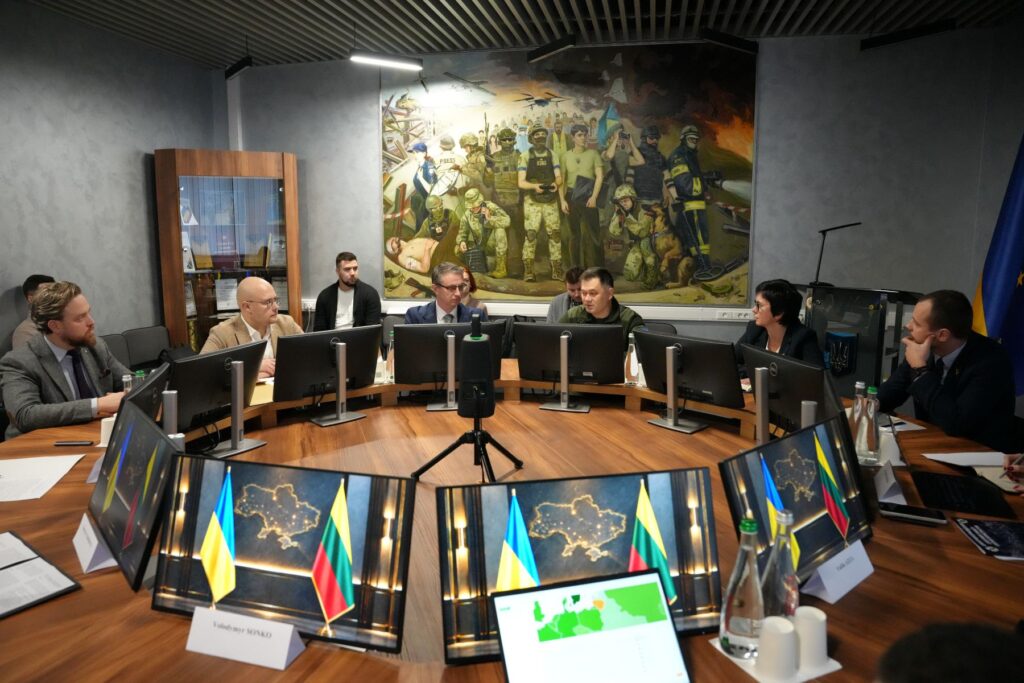
Last week, Director of the National Cyber Security Centre (NCSC-LT) under the Ministry of National Defence Antanas Aleknavičius paid a visit to Kyiv. The Lithuanian delegation was briefed on Ukraine’s experience in maintaining key state functions during crises. During the visit, the NCSC-LT and the Core Center of State Telecommunications (KVTC) signed a cooperation agreement with the Administration of the State Service of Special Communications and Information Protection of Ukraine (SSSCIP).
According to A. Aleknavičius, the agreement enables better information sharing among the NCSC-LT, the KVTC, and Ukraine’s SSSCIP on cyber incidents and threats, network and information system security, and vulnerability management.
“We are learning and gaining experience from our colleagues in Ukraine, where the fight takes place every minute, not just in the trenches, but in cyberspace as well. The ability to promptly exchange information on recorded cyberattacks, attack vectors, and trends will strengthen both countries’ cybersecurity and ensure timely prevention,” says NCSC-LT Director A. Aleknavičius.
The agreement centers on infrastructure and capability development: the signatory countries will share practical information in the course of developing Ukraine’s Regional Cybersecurity Centre network, implementing the CISO Campus project, and arranging specialized training programs, and will invite the SSSCIP to various professional forums on cybersecurity in Lithuania. They will also explore the possibility of integrating Lithuanian CERT/CSIRT teams into Ukraine’s threat information-sharing platform, MISP CERT-UA.
“We sincerely thank the Government of Lithuania and its people for the strong, unbreakable support. Both of our nations remember the Soviet past and understand armed aggression; therefore, our aim is to build a secure future for Europe. The Ukrainian cybersecurity system has to become an integral part of the wider European and Euro-Atlantic security architectures,” commented SSSCIP Head Oleksandr Potii.
He underscored that the bilateral partnership encompassed not just Lithuania’s support, but also Ukraine’s unique experience developed on the battlefield. The meeting delegations discussed the development of resilient government communication under missile fire and the work of Security Operations Centers (SOC).
The signed agreement expands the scope of NCSC-LT cooperation with Ukraine. Ukraine’s cybersecurity experts have been part of the multinational NCSC-LT threat analysis initiative, renamed as the International Cyber Threat Analysis Hub (HUB), since 2021. Besides Ukraine, the HUB also includes such members as the U.S., Poland, and the Czech Republic, exchanging data on cyberthreats, analyzing cyberattacks, conducting joint research, and sharing experience.
As a result of the cooperation, studies are published side by side with fellow experts from Ukraine and the other member countries. The analysis published in 2022 discusses the deployment of Russia’s offensive cyber capabilities in the war against Ukraine, and in 2025 – the comparative ratio of offensive Russian cyber capabilities from 2022 through 2025.
NCSC-LT has also supported the training of Ukraine’s cybersecurity cadets and provided the opportunity for specialists of the Armed Forces of Ukraine to improve their qualification in practical training delivered by U.S. instructors.


