


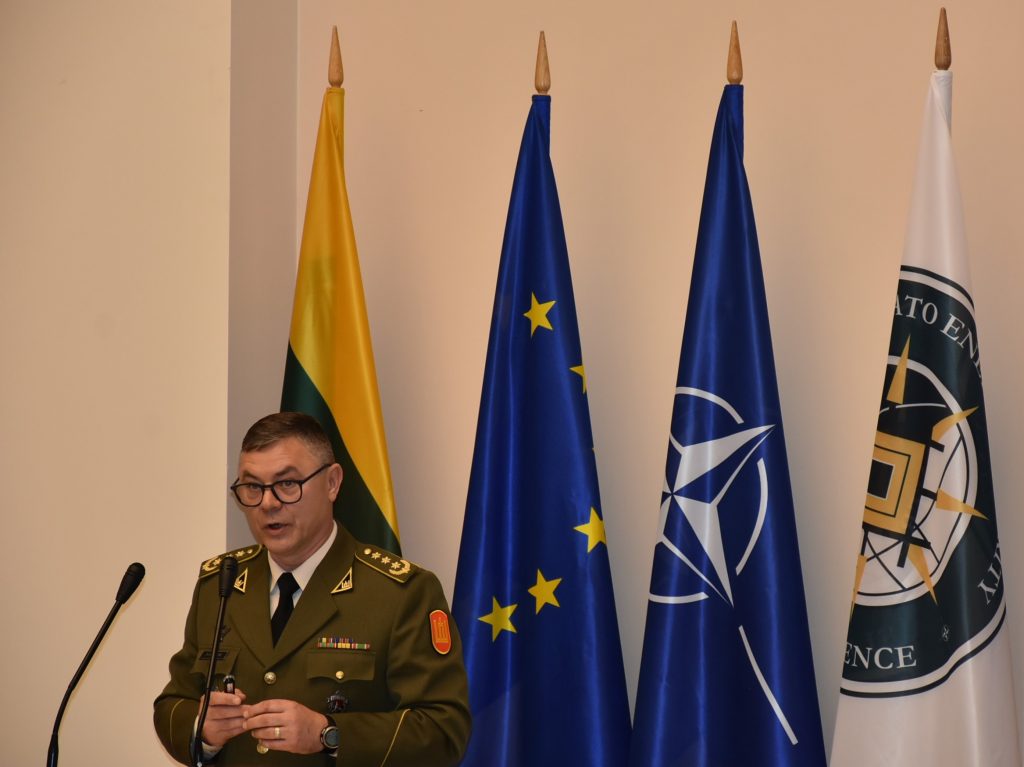
September 24, Coherent Resilience 2021 Balticׅs, an international table-top exercise based at the NATO Energy Security Centre of Excellence (NATO ENSEC COE) wrapped in Vilnius. It trained 100 participants from 12 countries to enhance the resilience of the Baltic electricity power supply against hybrid attacks which is particularly relevant to the ongoing Baltic electricity grid synchronization to Continental European network with a disconnect from the Russian Federation-run BRELL grid in view by 2025.
Exercise Coherent Resilience 2021 Balticsׅ also aimed to strengthen cooperation between the three Baltic states in order to increase the electricity power supply grid resilience and to raise awareness of the treats posed by the poor safety of Astravets Nuclear Power Plant.
As NATO ENSEC COE Director Col Darius Užkuraitis pointed out, the exercise tested the Baltic energy infrastructure and resilience against hybrid attacks. It focused on the “worst case scenario” developed considering the conclusions of the scientific research on Nuclear Energy and the Current Security Environment in the Era of Hybrid Threats co-authored by the NATO Strategic Communications Centre of Excellence (NATO StratCom COE) in Riga, NATO Cooperative Cyber Defence Centre of Excellence (NATO CCD COE) in Tallinn, and the European Centre of Excellence for Countering Hybrid Threats (Hybrid CoE).
“The objective of the exercise as to share international experience and enhance the skills of regional cooperation, mutual communication and assistance. It is necessary to have a common strategy that covers both, short-term and long-term activity. Our joint training consistently enhances the overall security of NATO allies,” Chief Advisor to the President of the Republic of Lithuania Darius Kuliešius said.
The week-long Exercise Coherent Resilience 2021 Balticׅ was organized by the NATO Energy Security Centre of Excellence and the European Commission Joint Research Centre.
The NATO Energy Security Centre of Excellence in Vilnius was established in July 2012 in order to carry out analysis of the diverse aspects of energy security, such as military energy efficiency and protection og critical energy infrastructure. It develops recommendations and proposals concerning energy security, alternative energy sources in the military, and development of environmentally friendly and efficient military capabilities.
Photo credit: NATO ENSEC COE


