


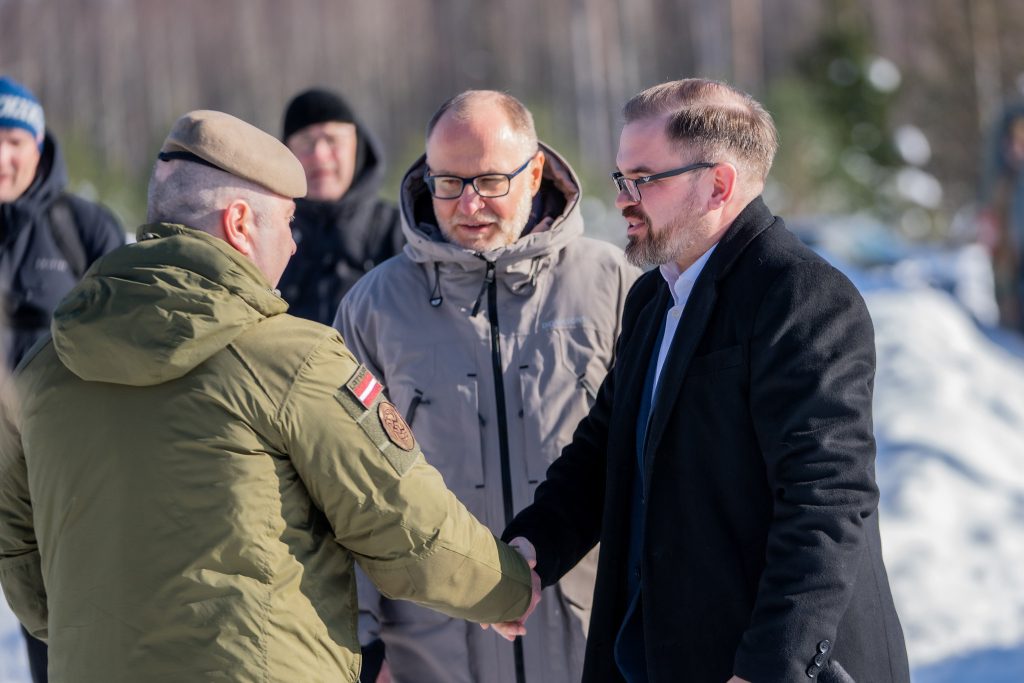
The Baltic states are consistently improving defensive capabilities of the eastern flank of NATO. Friday, Latvia unveiled its brand new Sēlija Training Area as Lithuania is gearing up to establish a brigade-sized training area in the vicinity of Kapčiamiestis and expand the Tauragė Training Area in Jurbarkas region. It is a strategic response to the security situation developments.
At the opening of the Sēlija Training Area Minister of National Defence Robertas Kaunas underscored that real deterrence begins with personnel readiness.
“Infrastructure investment today translated into security tomorrow. Modern equipment, Allied forces and defence plans are only actionable when there is personnel to act. Simulation systems and virtual trainers are important for readiness but not enough, solders must be real environment and real conditionswise. Training areas are not infrastructure for infrastructure’s sake, it is a critical element of personnel readiness and real deterrence to preserve security in the Baltic region,” said Minister R. Kaunas.
Sēlija Training Area: fundament for brigade-level training
Development of the Sēlija Training Area in Latvia is completed in phases. In the first phase in 2022–2025 a Logistics Area was built suitable for up to a section-level unit, as well as an Ammunition Storage, 300m Range, Tactical Infantry Platoon Range, machine gun and sniper rangers, UXO area. The state took 11 state-owned real property lots and 14 private lots as of right of eminent domain for the project.
In the next phase (2026–2029), Full Operation Capability will be reached and collective training infrastructure developed, so that a brigade-sized unit is enabled to rehearse maneuvers or NATO Allies can conduct major exercises.
Same threats faced throughout the Baltic region
The Russian military aggression against Ukraine has fundamentally changed the security architecture in Europe. Both Lithuania and Latvia have approx. 300 kilometers of border with Russia, therefore their security concerns are also almost identical.
Military training areas are built throughout the eastern flank of NATO: Latvia has unveiled the new Sēlija Training Area, Estonia already has large territories for training, Poland is mapping out upcoming development or corresponding infrastructure, while Germany is refurbishing old military bases.
Lithuania needs to continue developing military training areas
The planned military training area in Kapčiamiestis and development of the Tauragė Training Area in Jurbarkas region are directly linked with the formation of the national division and the growing number of NATO troops in Lithuania. Currently, only the Pabradė Training Area where the U.S .battalion is hosted accommodates brigade-sized training, and in part – the Gaižiūnai Training Area. The Rūdininkai Training Area will be dedicated for the German military personnel, while the remaining military areas can only accommodate up to a company or battalion-sized units. Thus, in light of the NATO regional defence plans and the security environment shifts, the State Defence Council took a decision to establish a new brigade-sized unit in in the vicinity of Kapčiamiestis in a strategic location near the Suwalki Gap, one of the most sensitive areas in NATO defence that connects the Baltic states with other Allies and at the same time separates Kaliningrad and Belarus.
Currently, all major training areas in Lithuania are situated in a ring shape in the most important territory in terms of defence: bordering Russia and Belarus – Pabradė, Rūdninkai and Tauragė. However, there is no corresponding brigade-training infrastructure in southern Lithuania. The proposed new area will ensure full-fledged brigade training, strengthen Lithuania’s hosting capacity and increase security throughout South Lithuania.
Economic impact: international experience
International experience shows that military sites drive regional economy not just strengthening national security but also creating new jobs and stimulating growth of local business. An excellent example of it is the Ādaži Municipality in Latvia: in 2017 when the NATO multinational unit was deployed, there were 600 people employed in the municipality. Over five years, the number surged by over 40% and over 2.7 thousand new jobs were created. Local businesses adapted to the new needs of the military and developed catering, posts, entertainment and beauty services. According to data of the Ministry of Defence of Latvia, military personnel deployed for training became so important as customers that they carried local business through the Covid-19 crisis.
Identical effects are anticipated in Lithuania. Approx. 100 different qualifications of engineers, environmental care, technical maintenance, upkeep, etc. personnel will be needed to man a brigade-sized training area. Besides new jobs in direct maintenance, more demand for local business will appear, such as catering, lodging, transport, technical maintenance, and other services. The lessons learned in Pabradė and Rukla demonstrate that military sites support local economy, create business opportunity and facilitate community.


