


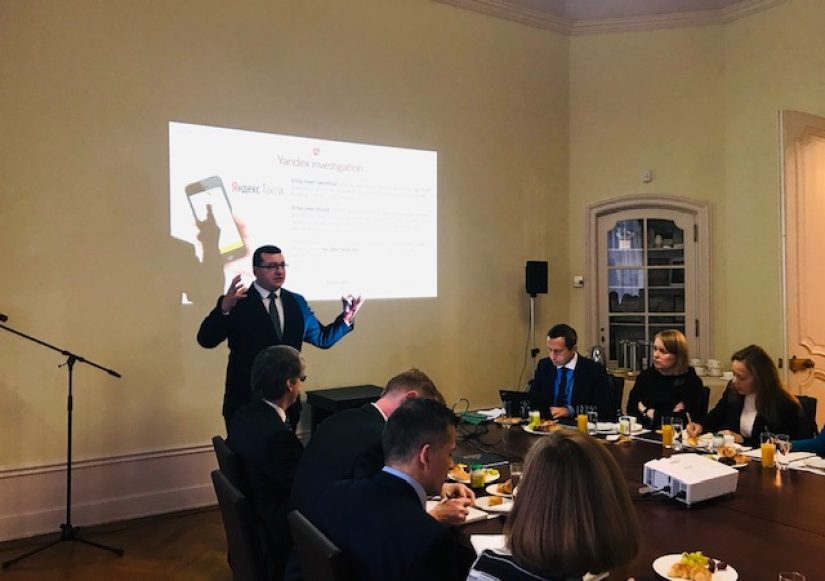
“Malignant activities of hostile states are intensifying and traditional spying activities are taken to cyberspace nowadays. We have the coordinated EU cyber diplomacy response measures – we must use them when the malicious actors are attempting to attack our institutions, business and society,” Vice Minister of National Defence Edvinas Kerza said to the Ambassadors of the EU member states gathered at the Permanent Representation of Lithuania to the European Union in Brussels Friday.
According to Vice Minister E. Kerza, the adversary found new ways and methods to make use of cyberspace and briefed the Ambassadors on the major IT device and app vulnerability analyses carried out by the National Cyber Security Centre.
Vice Minister E. Kerza also presented the progress made in the development of the Lithuanian-initiated EU Cyber Rapid Response Teams project.
“Just a year ago, we were still deciding whether such a force can be used in practice at all, but today we have a team formed by experts from different EU member states in reality and it is training in exercises in full force,” E. Kerza said encouraging EU member states to join the Lithuanian-initiated multinational project which currently includes 8 participants: Lithuania, Finland, Croatia, Netherlands, Romania, Estonia, Poland, and Italy that voiced its decision to join in recently.
The discussion with the EU Ambassadors and cyber security experts, as well as representatives of EU institutions, also concerned EU and member states’ efforts to mitigate the risks of using 5G networks , the need to certify objects of the Internet if Things and cyber-literacy of the society.
Vice Minister E. Kerza conducted the visit to Brussels on November 21-22 at the invitation of Ambassador Jovita Neliupšienė, Permanent Representative of Lithuania to the EU.
EU CRRTs
The initiative on the creation of Joint EU CRRTs and Mutual Assistance in Cyber Security project is one of the first 34 projects approved under the Council of the EU Permanent Structured Cooperation (PESCO) framework.
The multinational CRRTs comprise 6 to 8 cyber security specialists. The CRRTs could respond to cyber incidents within 72 hours from receiving requests from states, EU institutions, or military operations and missions.
The teams could also take preventive actions and carry out cyber vulnerability assessments. The multinational CRRTs are designed to ensure resources of states and institutions are used in the most effective manner when managing cyber threats. The first CRRT from the Netherlands formed in the framework of this project was on standby in 2019, in 2020 the baton is taken by a Lithuanian-led multinational CRRT.
The project is coordinated by a team of experts of the Cyber Security and Information Technology Policy Group of the Ministry of National Defence.
Photo credits: Permanent Representation of Lithuania to the EU


