


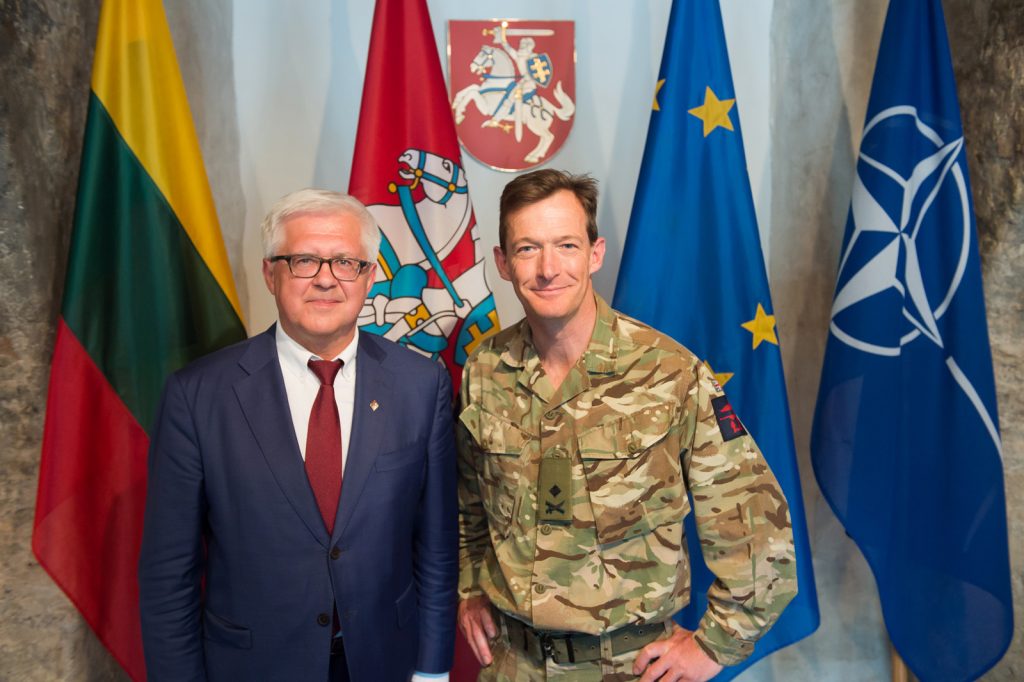
“We highly appreciate the United Kingdom-led Joint Expeditionary Force initiative, which allows us planning of a quick response in a potential crisis situation in the eastern NATO flank. JEF project is of utmost importance for Lithuania,” Vytautas Umbrasas, Vice-Minister of National Defence, said on June 13 at the meeting with the new Commander of Standing Joint Force Commander Major General Rupert Jones who has been in this post since November 2018.
The Vice-Minister underlined that the Joint Expeditionary Force fully opearational for a year now demonstrates good results and are of great value. “First maritime task group exercise Baltic Protector currently conducted in the Baltic Sea is an excellent proof of this,” the Vice-Minister said.
According to V.Umbrasas, UK participation in the “Baltic Protector” exercise undoubtedly demonstrates the UK’s commitment to security in Europe. He also emphasized that Lithuania has consistently advocated maintaining strong and close relations with the UK in security and defence even after Brexit.
In Vilnius Maj Gen R. Jones also met with the commanders of the Defence Staff of the Lithuanian Armed Forces and NATO Enhances Forward Presence Battle Group, discussed the issues of host support, the priorities of the Joint Expeditionary Force, and the exercise “Baltic Protector” which are happing in the Baltic Sea since the end of May. A total of 3,000 military personnel and 17 naval vessels from all JEF nations – UK, Denmark, Estonia, Latvia, Lithuania, Netherlands, Norway, Finland and Sweden – are involved in the exercise “Baltic Protector”. One of the final stages of the exercise will take place in June at the Lithuanian coast. JEF troops will complete a nighttime amphibious landing operation on the Baltic Sea coast and proceed to train tactical operations in Kairiai Training Area near Klaipėda with Lithuanian colleagues.
The UK-led Joint Expeditionary Force was established at the NATO Summit in 2014 and became operational after one year. The force reached Full Operational Capability in June 2018 with the signature of the Comprehensive Memorandum of Understanding in London and announcement of the force to be ready to act. Today the high-readiness rapid response force comprises 10 thousand troops can be activated to respond to emergencies in Europe and beyond any time necessary.
The Seimas of the Republic of Lithuania gave a mandate for the Lithuanian Armed Forces to take part in military operations as part of the NATO Response Force, European Union Battle Groups and the UK-led Joint Expeditionary Force, therefore, once there is a political decision, there is also the legal basis to deploy our soldiers at short notice and ensure crisis management.
One Lithuanian officer has been serving in the JEF operational headquarters in Northwood, United Kingdom, since early 2016. Lithuania is also contributing a company sized unit assigned to the Combat Group of the Danish Armed Forces and a military medic assigned to the UK field hospital. Up to Lithuanian 190 civilian and military personnel can take part in the JEF activities on the basis of the mandate provided by the Seimas this year.


