


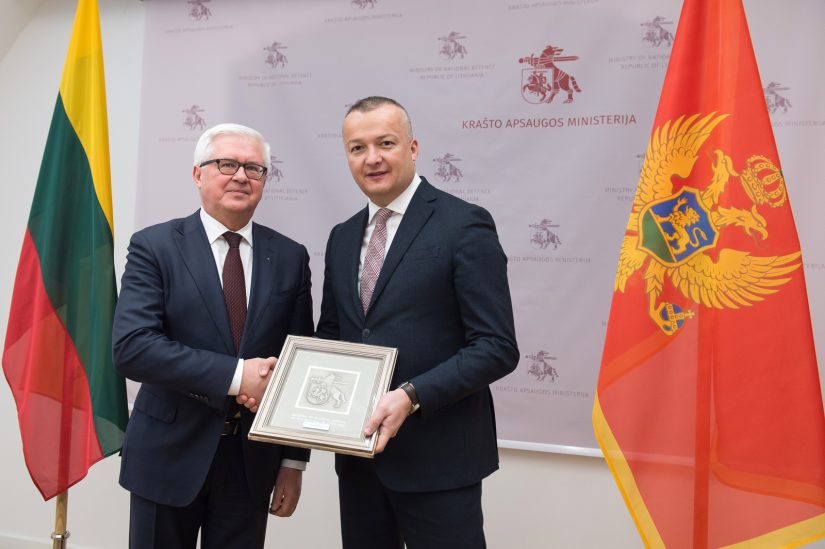
On February 14 Vice Minister of National Defence Vytautas Umbrasas discussed bilateral security cooperation, security challenges in the Baltic and the Balkan region, and regional security situation at a meeting Secretary of State for the Ministry of Defence of Montenegro Slobodan Filipović.
The officials agreed that Lithuania would share best practices in strengthening public resilience to hybrid threats and on increased cooperation on strategic communication and information exchange in cyber security. Another point of discussion was the countries’ participation in international operations to respond to threats to international security.
“Both, the Baltic states and the Balkans are facing similar challenges and we understand perfectly the threats from Russia to both countries,” Vice Minister V. Umbrasas said at the meeting and stressed that security could only come through close cooperation of NATO allies, including with Montenegro. Vice Minister also thanked for Montenegro’s contribution to stronger measures of deterrence at the eastern borders of NATO and by deploying troops to the NATO enhanced Forward Presence Battalion Battle Group in Latvia.
Secretary of State for the Ministry of Defence of Montenegro reciprocates the visit in Vilnius at the invitation of Vice Minister V.Umbrasas. The countries are faced with the same threats – aggressive disinformation campaigns, Montenegro was under particular pressure during the process of joining NATO to promote peace and stability in the Western Balkans. Secretary of State also visited the National Cyber Security Centre under the Ministry of National Defence to find out more about its activities and possibilities to establish a similar centre back home.
Secretary S. Filipović also visited the General Jonas Žemaitis Military Academy of Lithonia to familiarise with officer education in our country and discussed possibilities of closer cooperation in the area.
Defence cooperation between Lithuania and Montenegro is carried out on the basis of an agreement between the countries’ Ministries of Defence signed in 2013. The countries agreed to cooperate on democratic control of armed forces, development of legal basis for armed forces, defence policy and strategy, defence planning and finance, and other areas of mutual interest.
Montenegro became a member of NATO on 5 June 2017, it has also achieved the biggest progress so far as a candidate in the negotiations for EU membership launched in 2012.
Photo credits: Aistė Janulevičiūtė (Military Academy of LIthuania), Alfredas Pliadis


