


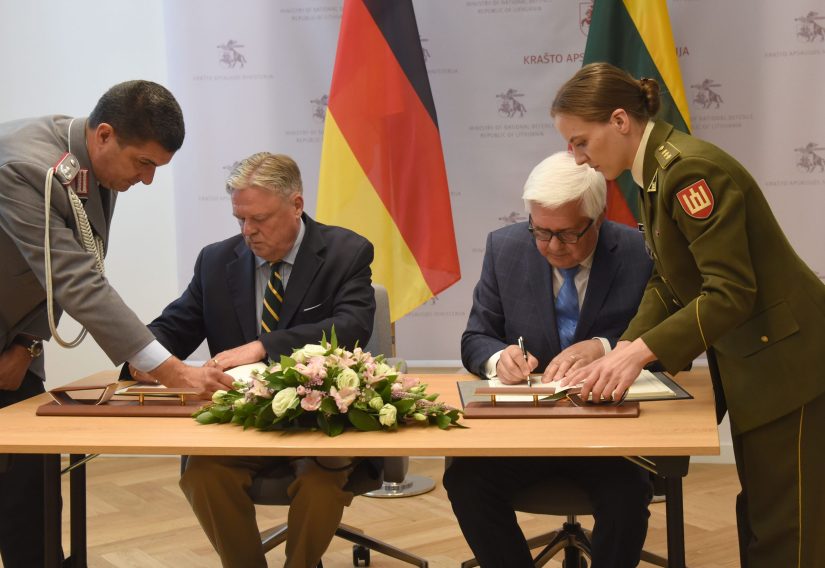
As enhancement of defence cooperation between Lithuania and Germany continues, Agreement between the Government of the Republic of Lithuania and the Government of the Federal Republic of Germany concerning Temporary Stays of Members of the Armed Forces of the Republic of Lithuania and the Armed Forces of the Federal Republic of Germany in the Territory of the Other State was signed on June 30 at the Ministry of National Defence. The document was signed by Vice Minister of National Defence Vytautas Umbrasas on behalf of the Lithuanian Government and Ambassador of Germany to Lithuania HE Matthias P. Sonn on behalf of the Federal Government. Lithuania had a status of forces agreement of such level only with the United States of America so far.
“Germany is the key ally and support of the stability and security of Europe. This Lithuanian-German defence cooperation relationship has been in the works for the past 30 years, though in recent years this cooperation has blossomed into a full-fledged relationship in a number of areas, including procurement and acquisition, training and education, international missions and operations as well as readiness and deterrence initiatives. This ceremony is just another essential piece to the steadily growing defence cooperation between our countries,” Vice Minister V. Umbrasas said. According to Vice Minister, presence of German troops in Lithuania and participation of Lithuanian troops in military activities in Germany not only increase the interoperability of German and Lithuanian forces but also significantly contribute to a stronger security of the Baltic region.
“Today’s signatures represent what has perhaps become one of the most central elements in the Lithuanian-German partnership: we jointly defend our alliances’s collective security together, right here in Lithuania. With German “boots on the ground”. This will no doubt continue as long as Lithuania requires it. That’s why it makes sense to formalize for the future what has already been working well in practice. It makes me proud, as Germany’s ambassador to our ally Lithuania, to be part of a relationship that is equally essential for the security of both our countries,” Ambassador Matthias P. Sonn said at the ceremony.
The agreement lays out terms for temporary stay of troops of armed forces of Germany and Lithuania deployed in each other’s territories for training and exercises. Additionally, the document will serve as a basis to set supplementary or new rules concerning some aspects of military cooperation: for example, in setting the limits on the number of deployed troops and the period of time of their stay in the host nation, additional requirements for state of health certification for members or armed forces deploying to a host nation. The agreement will also set regulations on the areas not covered by the NATO Status of Forces Agreement (NATO SOFA) signed in 1951, such as, environmental protection (respecting environmental sustainability, prioritising travel by railway), telecommunications (limitations on radio frequencies use for advertising, jamming), and others. The agreement also defines terms for humanitarian assistance and search and rescue operations.
Germany was the initiator of the signature of the agreement.
The document will come into force when it is ratified by the Seimas of the Republic of Lithuania.
Germany significantly contributes to the development of Lithuania’s defence capabilities. Germany is a longstanding partner to Lithuania in upgrading our Armed Forces, weaponry and military equipment, Lithuania procures from Germany Vilkas Infantry Fighting Vehicles, Pz2000 self-propelled howitzers, M577 armoured personnel carriers, etc. The countries also cooperate on developing and improving battalions of the Lithuanian Armed Forces and their infrastructure. Germany is also the framework nation of the NATO enhanced Forward Presence Battalion Battle Group deployed for deterrence and defence purposes in Rukla in early 2017, and has the largest portion of troops there. A Mechanised Infantry Brigade of the Lithuanian Armed Forces was affiliated to a German Bundeswehr Division in 2018, it increases training opportunities for soldiers of both countries. Germany is also an active participant of the NATO Air Policing Mission in the Baltic states and delegates officers to the NATO Force Integration Unit in Vilnius.
Photo credits: G.Maksimovicz


