


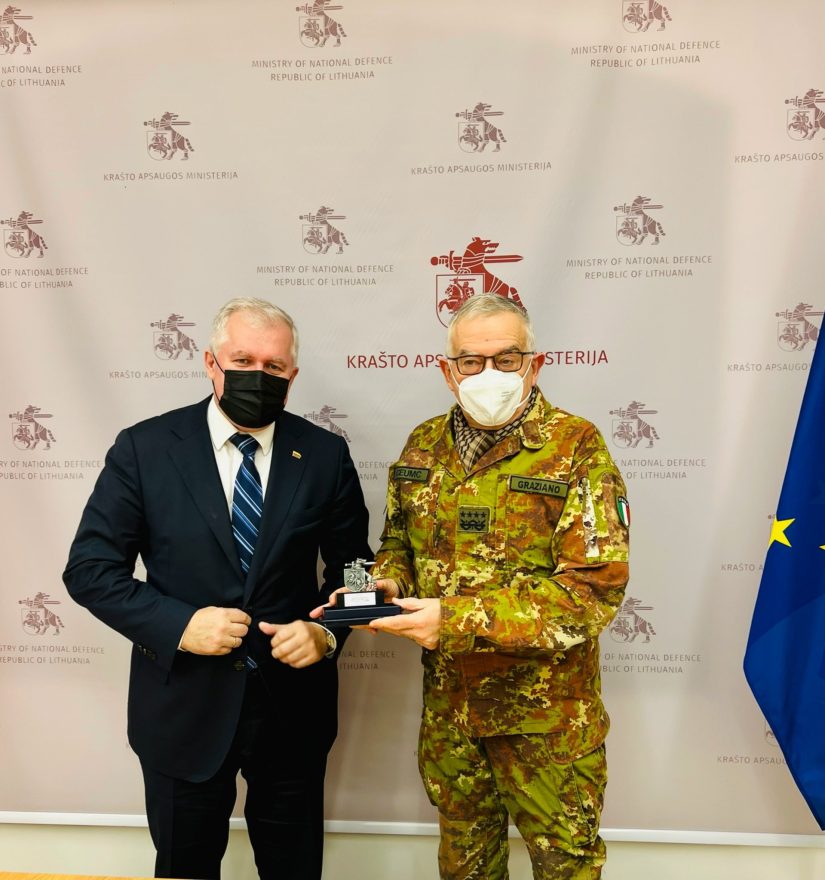
Friday Minister of National Defence Arvydas Anušauskas met with Chairman of the European Union Military Committee General Claudio Graziano to discuss the unusual Russian amassing of forces on the border with Ukraine. Minister underscored that the EU should not be a passive observer.
“We have to be active and not turn into passive lookers-on as Russia is unusually building military capabilities on the border with Ukraine – because a submissive and receding position will not respond to the caused tension and concern. The situation is made even more complicated by the disinformation and psychological operations that Russia is using against Ukraine. Our support might strengthen the common Russian deterrence policy,” A. Anušauskas.
A. Anušauskas pointed out to Gen C. Graziano the EU military training and advisory mission that Lithuania initiated for Ukraine. According to Minister, the EU should support Ukraine’s resolve to reform its defence sector, and such support would not only strengthen the security and stability not only of Ukraine but of the entire EU. A. Anušauskas underscored that the military mission in Ukraine would focus on professional military education.
Minister also thanked General for the Frontex support on the border with Belarus and stressed that it was the proper compatibility between the national and the Frontex effort that could be an effective measure in irregular migration management. According to A. Anušauskas, if the EU wants to be an important geopolitical player, all EU member states have to spend at least 2 percent of GDP on defence.
“Europe’s strength will lie not in its declarations but in its work,” said Minister.
The guest also met with Chief of Defence Lithuania Lt Gen Valdemaras Rupšys, Speaker of the Parliament Viktorija Čmilyte-Nielsen, members of the Committee on National Security and Defence Minister of National Defence. After meeting with Minister, Gen Claudio Graziano met with the MoD Cybersecurity Rapid Response Team.
General and his delegation are also planned to visit the border area with Belarus, meet with Border Guard Service officers and military personnel that assist them.
The EU Military Committee (French: Comité militaire) is the highest structure of military command in the EU. Composed of EU Chiefs of Defence, it leads EU military activity, primarily, the Common Security and Defence Policy military missions and operations planning and execution and development of military capacity. The EU Military Committee also forms military advice and recommendations to the EU Political and Security Committee which shapes the Common Security and Defence Policy. Chiefs of Defence of EU member states meet twice a year in Brussels.


