


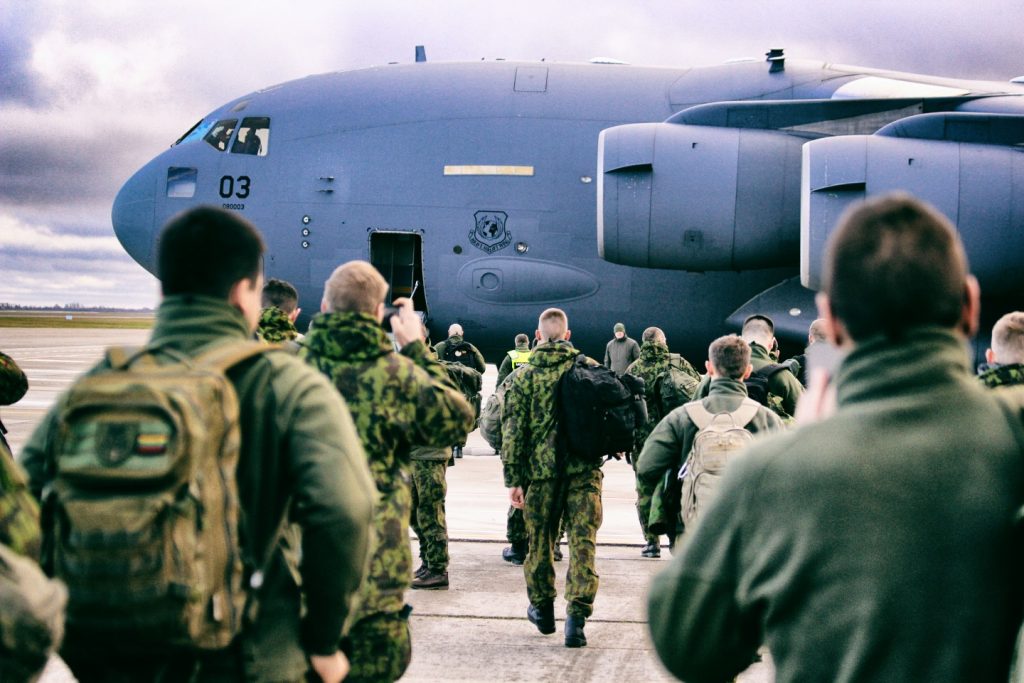
In 2021-2022 military and civilian personnel of Lithuania will continue completing standby periods for multinational rapid response forces – the NATO Response Force (NRF) and the UK-led Joint Expeditionary Force (JEF), and serving with military commands of NATO and the EU. It was tabled for approval of the Seimas of the Republic of Lithuania in a Ministry of National Defence draft resolution on October 15.
The maximum number of military and civilian personnel to be assigned for the NATO Response Force is provided to be 200 in 2021 and to be increased to 301 in 2022. Up to 142 civilian and military personnel are planned to be on standby for the UK-led Joint Expeditionary Force in 2021-2022. The maximum number of 131 military and civilian personnel of the National Defence System is planned to be delegated to military NATO and EU commands.
“Approval of the draft resolution will enable Lithuania to fulfil our commitments to the Alliance and the EU in a timely and appropriate manner by deploying to international operations units and personnel held on standby for international rapid response forces ,” Minister of National Defence Raimundas Karoblis says.
The NATO Response Force are formed by capabilities contributed by NATO allies. The capabilities are selected by NATO experts in accordance with their level of preparedness and the need. The NRF is composed of the Very High Readiness Joint Task Force (VJTF), the Initial Follow-On Forces Group (IFFG), and Follow-On Forces Group (FFG). The core of the VJTF is formed by French, German, Italian, Polish, Spanish, British, and Turkish forces. Duration of one rotation of the NATO Response Force is 12 months. During that period, the North Atlantic Council can decide to deploy NATO allies’ forces kept on standby for the NRF to an international operation. The NRF is made up of land, air, maritime and special operations forces components. Lithuania has been contributing to the NRF since 2005.
Lithuanian servicemembers are also on standby for the Joint Expeditionary Force. Established in 2014 by the initiative of the United Kingdom, the JEF is currently formed by land, air and maritime components contributed by Sweden, Denmark, Finland, Netherlands, Norway, Estonia, Latvia, and Lithuania. The JEF is a high readiness force that can be deployed to multinational operations led by NATO, UN, or partner states. JEF objective is to complete wide spectrum military operations, including deterrence, combat actions, and humanitarian assistance. Deployment of JEF components is decided by the contributing countries. The force is led by the Operational Headquarters of the United Kingdom.
In 2019–2020 Lithuania was contributing a company-sized infantry unit. An infantry unit and a military medic are also planned to be delegated in 2021–2020. Lithuanian forces on standby for the JEF would be deployed to international operations only if the framework nation United Kingdom decided to after consultations with and on the basis of agreement from the other force-contributing partner nations.
Lithuanian soldiers serve in their homebases during the standby for international rapid response units periods. The rapid response units maintain high readiness to deploy to the area of assignment within a set time in case a decision is made to use the international rapid response force in an operation.
The Seimas is expected to consider the resolution in a session in November.
Photo credit: Arnas Čemerka (MoD archive)


