


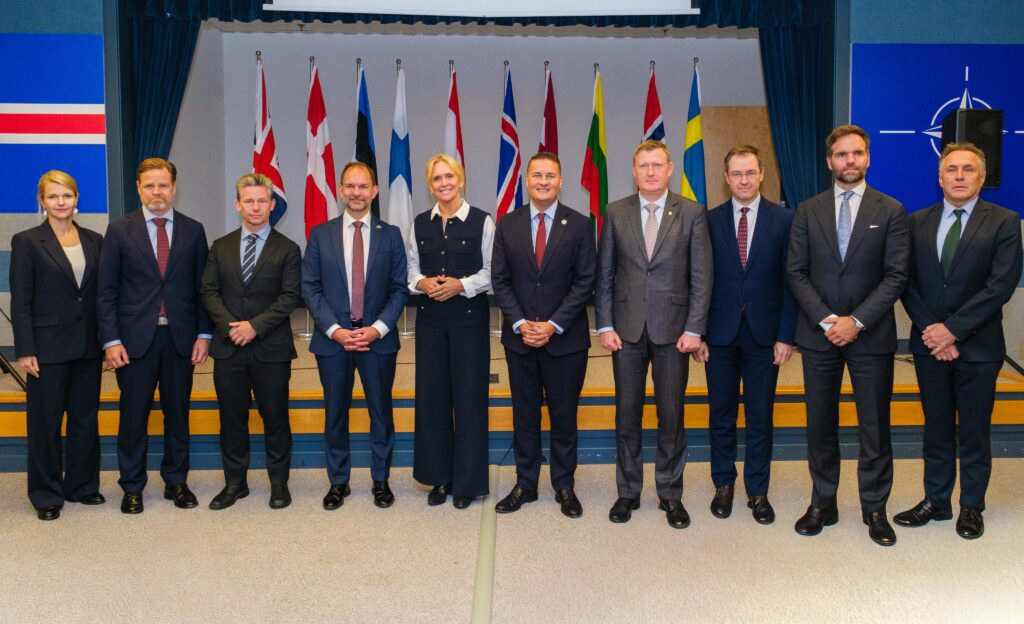
Vice Minister of National Defence Karolis Aleksa took part in the UK-led Joint Expeditionary Force (JEF) Defence Ministers’ meeting in Reykjavik. The meeting was focused around the security situation in the region, practical cooperation with Ukraine, hybrid threats, and further operational activity of the JEF.
In the presence of Ukraine’s representatives, Vice Minister underscored at the meeting Lithuania’s support for Ukraine’s further involvement in JEF activities and expansion of an enhanced partnership.
“Ukraine’s attendance at today’s debate is vital. The country has gained a unique operational experience of contemporary warfare that every JEF Nation can benefit from. The next step must be clear: targeted joint activities and practical cooperation with Ukraine to strengthen military capabilities. Ukraine’s experience accumulated in this war needs to be integrated into our common defence. Likewise, further assistance for Ukraine and its coordination is key,” said Vice Minister K. Aleksa.
According to Vice Minister, it is particularly important to apply Ukraine’s experience in practical force training and activity in the areas that can give the most significant added value for JEF readiness, interoperability and adaptability to the ever-changing character of modern warfare.
JEF exercise – testing readiness for joint action
Another topic discussed at the meeting was the JEF operational activity and Exercise Lion Protector held earlier this year. The training event was designed not just for training separate capabilities but also for testing the practical JEF capability as a multilateral unit.
The JEF Nations trained for critical infrastructure protection against attacks and sabotage, tested general command and control procedures, and the ability to coordinate actions quickly across the region. The exercise area spans the North Atlantic, the High North and the Baltic Sea region, with forces operating at sea, on land and in the air.
“The value of the JEF is measured in what we can do together. Joint operations and exercises showcase our forces training and acting together, and strengthen readiness to counter real threats. This is particularly important for the Baltic states – we need to be prepared to act quickly, in a coordinated manner, and across different areas,” Vice Minister said.
According to K. Aleksa, practical JEF activities are also instrumental in enhancing the ability to take decisions quickly, to coordinate forces of different nations, and to ensure that political decisions are translated into concrete actions promptly.
Response to hybrid threats and a joint message
The JEF Defence Ministers also discussed the future of the Euro-Atlantic security – hybrid threats, potential scenarios of escalation and strengthening the joint political and military response.
“We must not just know how to respond to the arising threats but also to agree in advance on our actions and communication. The JEF needs the capacity to take decisions quickly and in a coordinated manner thus sending a clear message,” said K. Aleksa.
The JEF Defence Ministers also discussed the wider Euro-Atlantic security context, Canada’s role and the possibilities to strengthen the country’s contribution to the regional security with representatives of Canada who attended the meeting. Other topics addressed were increasing resilience, joint peacetime activity and readiness to respond to threats below NATO’s Article 5 threshold.
Focus on the Baltic Sea security
A considerable emphasis was given to naval cooperation and the new JEF’s Delivering Collective Maritime Advantage Initiative aimed at strengthening the long-term and more tightly integrated collaboration of the Nations at sea through a closer planning coordination, training, and capability development and maintenance.
“Lithuania is looking for a consistent and visible JEF maritime presence in the Baltic Sea. A closer coordination of planning, exercises and capabilities would strengthen deterrence, improve maritime situational awareness, and allow the Allies to take joint action more rapidly,” K. Aleksa underscored.
The JEF Nations approved the resolve to continue further strengthening the cooperation in the Baltic Sea, the High North and the North Atlantic regions, with a particular focus on hybrid threats, resilience and readiness for joint action.
The JEF is a United Kingdom-led Northern European format for regional security composed of ten members: Framework Nation the United Kingdom and nine Participating Nations –Denmark, Estonia, Finland, Iceland, Latvia, Lithuania, the Netherlands, Norway and Sweden. High readiness rapidly deployable maritime, air and land capabilities of the Joint Expeditionary Force are tailored to respond to full-spectrum threats, complement NATO efforts, and act in the Baltic Sea, the High North and the North Atlantic regions in a coordinated manner.


