


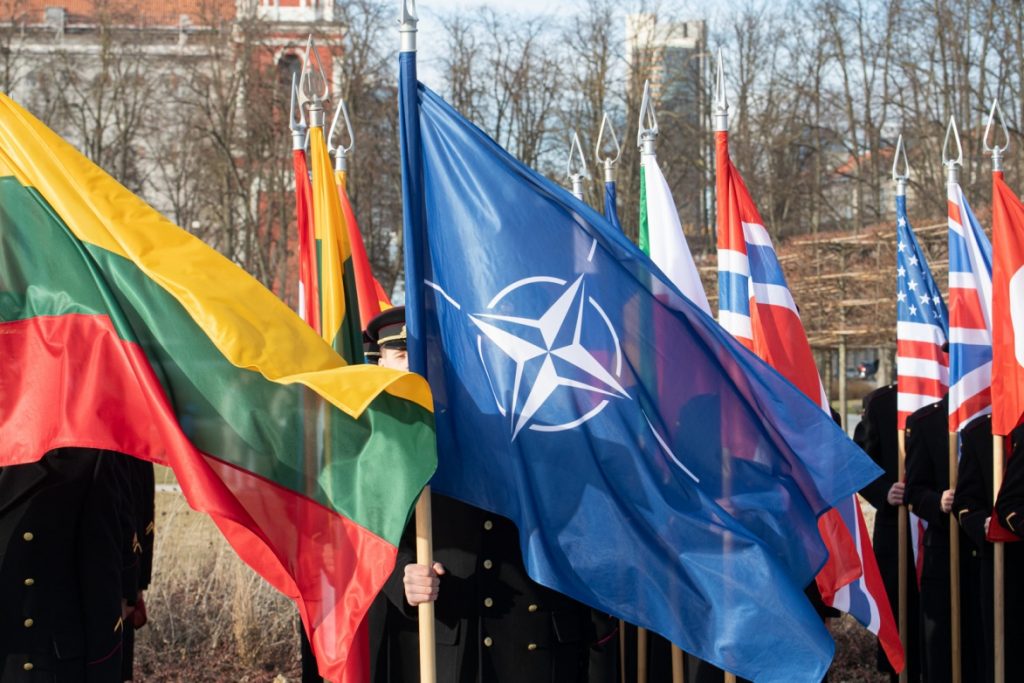
Lithuania’s nineteenth year as a member of NATO has been marked by Russia’s brutal war in Ukraine. A war of scale that has taken Europe back to reality forgotten for eight decades, a war that the Kremlin regime expected to break the entire free world, not just Ukraine.
The Kremlin’s plans were destroyed by the resolute response of the heroic Ukrainian defenders and their donor countries alike. A number of strategic shifts have taken place in the thinking of individual countries last year. Red lines were crossed – and eventually recognized as self-imposed. Above all, however, is the importance of Lithuanian, Allies’ and NATO-level decisions on strengthening collective security.
The Euro-Atlantic space is no longer at peace. The international community recognized it early in the morning of 24 February 2022. It is also the admission that opens the strategic environment review part in the NATO cornerstone document, the Strategic Concept, endorsed last year. NATO goes back to its roots, the collective defence, completely to reliably ensure defence of Alliance territory from the firs inch. A lot needs to be done before the decision is fully delivered on, still it signifies that the fundamental shift in thinking, strategy and planning has already happened. It is a particularly good sign for Lithuania and the other eastern members of the Alliance.
The Alliance has responded to Russia’s war in Ukraine by significantly strengthening the deterrence, as well as readiness for defence in case it is required. Thousands of additional troops have been moved to the eastern flank, air and maritime capabilities raised alert levels and intensified activities. NATO leaders unanimously agreed at the Madrid Summit in June to continue building on deterrence and defence in the eastern flank of NATO, authorized establishment of four additional enhanced Forward Presence (eFP) Battle Groups and allowed for NATO eFP extension to brigade level.
The NATO eFP Battle Group Lithuania was strengthen with additional Allied troops, the NATO Air Policing Mission as well. The United State stepped up its presence on the ground and confirmed the uninterrupted rotational force presence. The Joint Communique signed by the President of the Republic of Lithuania Gitanas Nausėda and the Chancellor of the Federal Republic of Germany Olaf Scholz on increasing German troop contribution in Lithuania is already delivered on: proper military infrastructure for hosting Allied forces is developed, regular consultations with Germany address increasing their presence in Lithuania.
Russia has suffered a strategic defeat in Ukraine. The wide-ranging international coalition of countries who provide assistance to Ukraine, including our country, are doing everything possible to advance Ukraine’s ultimate victory in this war. However, plans of the Kremlin regime speak of a decision to pursue a prolonged confrontation with the West, and to restock, expand the military capabilities necessary for its imperialistic goals even at the expense of the basic economic and social needs of the Russian citizens. As such, Russia stands as a long-term military threat to NATO and as an existential threat to the eastern flank of it.
We are entering the year of the 20th anniversary of NATO membership in intense preparations for the NATO Summit in Vilnius in July. It is doubtlessly the most important international event to take place in Lithuania over the entire period of since the re-establishment of independence. But it is not solely significant for attracting the global attention to a capital 30 km away from the eastern border of NATO. Decisions will be taken in Vilnius to further build on the reorientation to collective defence – something more than symbolic, but rather, critical for the security of our region.
We aim to secure progress towards the deterrence and defence agenda goals, forward defence decisions ahead of the Vilnius Summit. In the meanwhile, work is ongoing in bilateral format concerning the German enhanced Vigilance Activities Brigade in Lithuania which is a deterrence and forward defence element.
NATO Allies agree that defence subject-matter has been marginalized for years which means that defence investment needs to be increased to rebuild and develop the necessary capabilities. We aim to ensure that Allied commitment to a consistent increase in defence spending is renewed at Vilnius. The 2014 commitment to 2% of GDP needs to be stepped up in the current security environment: 2% of GDP being the floor, not the ceiling. We already present a role model for the Alliance with own, significantly exceeding defence spending.
We hope to be able to welcome Sweden and Finland as full-fledged NATO members in Vilnius. Accession of the countries with powerful militaries will significantly enhanced the security in the Baltic Sea region, i.e., of Lithuania as well. Another focus of our intense efforts is elevating the Ukraine-NATO relations to a higher level that will eventually lead to Ukraine’s inevitable NATO membership.
The Euro-Atlantic space is not at peace, but the sword and shield of the Alliance stands a strong guard of its members. The decisions adopted last year takes NATO back to its collective defence roots, which significantly boosts Lithuania’s security and reconfirms the importance of NATO membership. At the same time, the support of the Alliance to Ukraine and the commitment to continue as long as victory takes proves that the resolve to bring back peace to Europe is steadfast and it will be done.


