


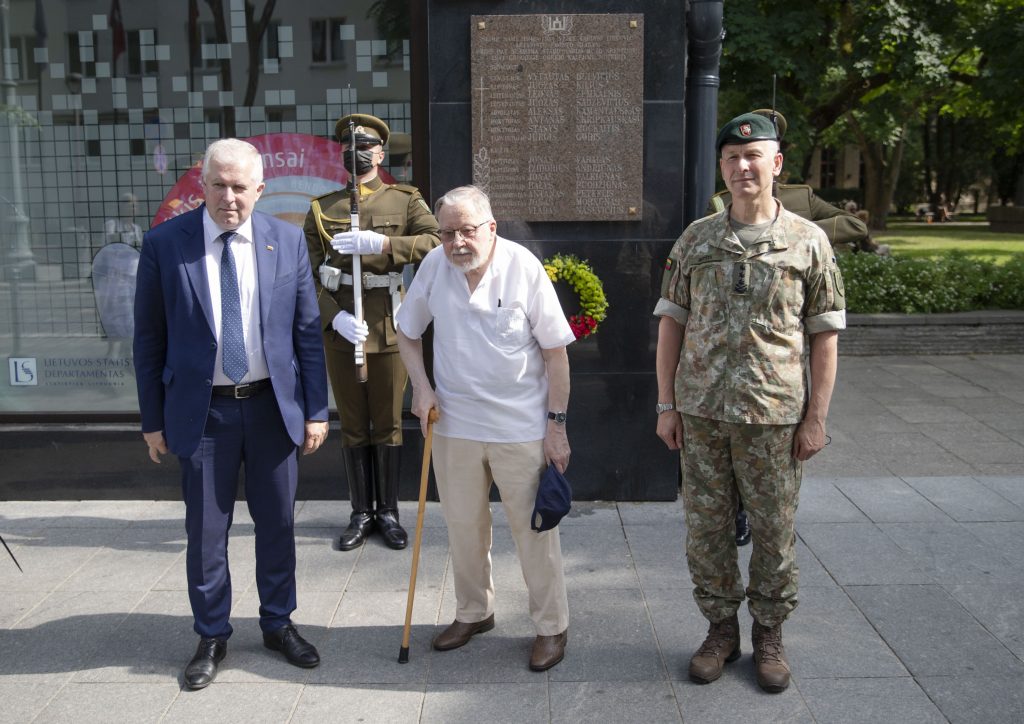
On June 23 Minister of National Defence Arvydas Anušauskas, Chief of Defence of Lithuania Lt Gen Valdemaras Rupšys and Chairman of the Supreme Council – Reconstituent Seimas of Lithuania Prof Vytautas Landsbergis laid flower wreaths at the 23 June 1941 Uprising memorial plaque in tribute to its participants on the 80th anniversary of the uprising against the occupying Soviet rule. The memorial plaque marks a building on Gedimino av. that served as the anti-Soviet June Uprising organizational headquarters.
“The 23 June 1941 Uprising was a reaction to the most brutal “red terror”, deportations, several tens of massacres across Lithuania that took place that June. The uprising participants were fighting for their right to be a nation and a country free of any bondage,” said Minister of National Defence after paying respects at the June 23 Uprising memorial plaque.
Minister accentuated that the insurgents help to free thousands of detainees across Lithuania, including Jewish and Russian people, out of the red terror grip. “In Kaunas alone, almost 2 thousand lives were saved, including Juozas Lukša-Daumantas to whom this year has been dedicated. He was as young student at that time, caught in the grip of the Soviet security structures,” said A. Anušauskas. “We cannot forget thought that persecution and killing of the Jews began at that time as well.”
“Everyone has to respect those fallen for the freedom of Lithuania: they are the people who laid their lives for our future. Participants of the military uprising of 1941 were trying to restore the statehood of Lithuania on their own, no allies, no support, no regard to own lives. They did not manage. An estimated approximately 2000 brothers in arms fell. We, the soldiers, pay respect to our fallen brothers in arms and we attest that the freedom of Lithuania will stand the highest aim of our service. We cannot allow to vilify the heroic deeds of our soldiers or we can be vilified in the future for having created our state unduly. Let’s remain steadfast in our guard of the future of the Motherland,” said Chief of Defence Lt Gen Valdemaras Rupšys.
Flower wreaths were also laid at the memorials for June 23 Uprising victims in Rasų Cemetery in Vilnius and The Old Kaunas Cemetery – Tranquility Park.
The anti-Soviet uprising of 1941 was organized in an effort to utilize the German – USSR war that started in June 1941. As the Red Army was retreating from Lithuania, the occupying regime executed a number of war crimes – massacres of civilians and political prisoners. The insurgents had an aim to draw the invader USSR army out of Lithuania and re-establish independence.
Photo credits: Sgt Spc 1st Class Ieva Budzeikaitė, Giedrė Mkasimovicz Alkema


