


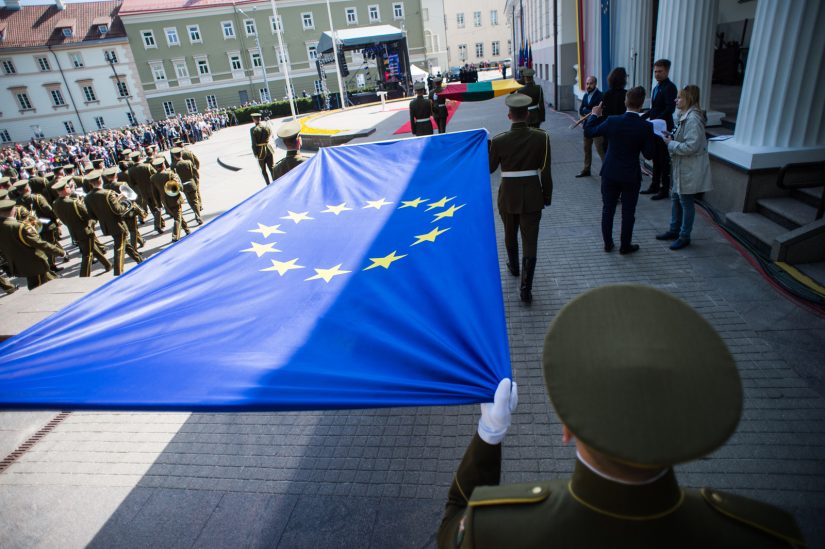
Lithuania marks the 17th anniversary of European Union membership on May 1. A full-fledged member of the EU since 2004, Lithuania has been given the opportunity and the incentive to be a strong and modern country – which is clearly reflected in the national defence policy. On the occasion, Vice Minister of National Defence Margiris Abukevičius told about the meaning of cooperation in EU formats to the security of Lithuania and the entire Europe.
“Even if Lithuania is not a sizeable country, we are active in the process of shaping the European Union Common Security and Defence Policy. Both ways, by presenting its standing on political issues and by contributing to concrete EU initiatives,” says M. Abukevičius. He stresses that the Lithuanian participation in the European defence initiatives is not only active but also constructive.
The work with the EU partners on military mobility is particularly intense – it is directly related to the necessity to ensure a quick and undisrupted deployment of allies into the region. Lithuania currently presides over a European Defence Agency working group for simplification and unification of transit procedures. The effort is very relevant to the NATO alliance as well.
“We have to understand that we do not mean hard security when we are talking about the European Security and Defence Policy. That is NATO’s jurisdiction, it is the main defensive organisation. However, the EU can really supplement NATO security assurances and its instruments. Four major areas can be distinguished that Lithuania puts most emphasis on: military mobility, increasing resilience, development of EU partner nations, and defence industry,” says M. Abukevičius.
The European Union has started active efforts for increasing European security and defence capacity in the recent years. The Permanent Structured Cooperation (PESCO) has been developed since 2017, financial instruments for projects in defence area – the European Defence Fund and the EU funding for improving military mobility – have been initiated.
That was a result of a EU member states’ recognition that insufficient investments had been made in defence area, necessary military capabilities had not been developed, and no instruments for a quick and effective response to conventional, hybrid and cyber threats on the European borders were available.
“Quite a few changes have been introduced in the European defence over the recent years. The focus on defence cooperation has been significantly increased. This is a natural process that we can call normalization of defence policy. It is becoming one of the European policy sectors that is receiving both, attention and financing. That results in very concrete instruments,” says M. Abukevičius.
The European Union conducts a range of military operations that Lithuanian military personnel steadily contributes in. Lithuanians are currently serving in international operations IRINI and ATALANTA in the Mediterranean and military training operations in Mali and the Central African Republic. According to Vice Minister, Lithuania’s active engagement in the EU cooperation formats does not go unnoticed.
In 2017 Lithuania was entrusted with leading the PESCO project on Cyber Rapid Response Teams and Mutual Assistance in Cyber Security, currently one of the most processed and successful PESCO projects. The response teams are generated to support EU authorities, agencies and institutions, with a long-term goal of refining the unified EU response to large-scale cyber incidents and crises.
“The EU cooperation on cyber security to date has mainly concerned information exchange, however, there was a real need for a EU-level capability suitable for responding to a large cybersecurity crisis. Lithuania took the initiative to create an operational multilateral force – it has been developed very quickly and has been on standby successfully for two years already,” tells M. Abukevičius.
Lithuania’s European defence policy priorities also reflect the strategic approach to NATO-EU cooperation. Lithuania upholds that the EU can not afford obstructing or underestimating the partnership with NATO allies. We are strongly convinced that strengthening and improvement of the transatlantic relations has to be one of the cornerstones of the European Common Security and Defence Policy.
“Europe wants a more active role in security and defence and plans investing more, and Lithuania is a part of these processes. It is important to be in the spearhead of shaping the direction of the Common Security and Defence Policy. We believe the direction should be to complement NATO security assurances and current instruments,” states Vice Minister of National Defence M. Abukevičius.
Photo credit: MoD archive.


