


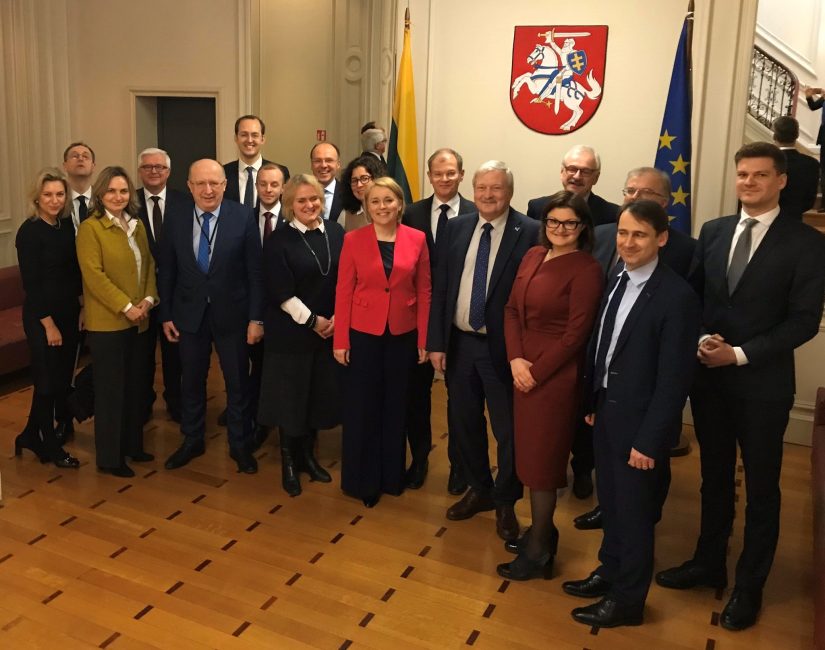
On March 1–4 Vice Minister of National Defence V. Umbrasas attended the annual off-site session of the European Union Commission of the Government of the Republic of Lithuania in Brussels. V. Umbrasas also met with representatives of NATO and EU agencies during the work visit.
At a meeting with Timo Pesonen, Director-General at the Directorate General of Defence Industry and Space established by the new European Commission Vice Minister discussed priorities of activities and tasks of the new agency. Vice Minister reiterated Lithuania’s interests to ensure opportunities for small and medium business to participate in tendering procedures at the newly established European Defence Fund, and pointed out the added value for developing the defence sector through provision of opportunities for NATO allies to participate too.
Vice Minister also discussed the most topical EU defence issues, including the ongoing review of the Permanent Structured Cooperation (PESCO) in defence and prospects of its further development, defence initiatives in the new EU multiannual financial framework, Lithuania’s participation in EU operations, and other issues, with Acting Managing Director for Common Security & Defence Policy and Crisis Response of the European External Action Service Pawel Herczynski.
The meetings particularly focussed on military mobility in the EU multiannual financial framework 2021–2027. Vice Minister expressed serious concern on the proposals put forward during negotiations to significantly cut or give up altogether financing for the initiative. “It would be extremely bad news to us and to our NATO allies. Europe should show responsibility and implement defence policy priorities, with a particular focus on military mobility,” Vice Minister said.
At a meeting with Assistant NATO Secretary General Patrick Turner Vice Minister talked about the security situation in the Baltic Sea region and NATO deterrence and defence measures. Vice Minister underscored the importance of ensuring readiness of forces and timely reinforcement to allies, discussed continuing militarisation of Kaliningrad and Russian missiles that are developed in violation of international Russia’s commitments, presented threats and NATO’s response measures, as well as their further strengthening. Priorities of the Lithuanian Armed Forces development were also discussed.


