


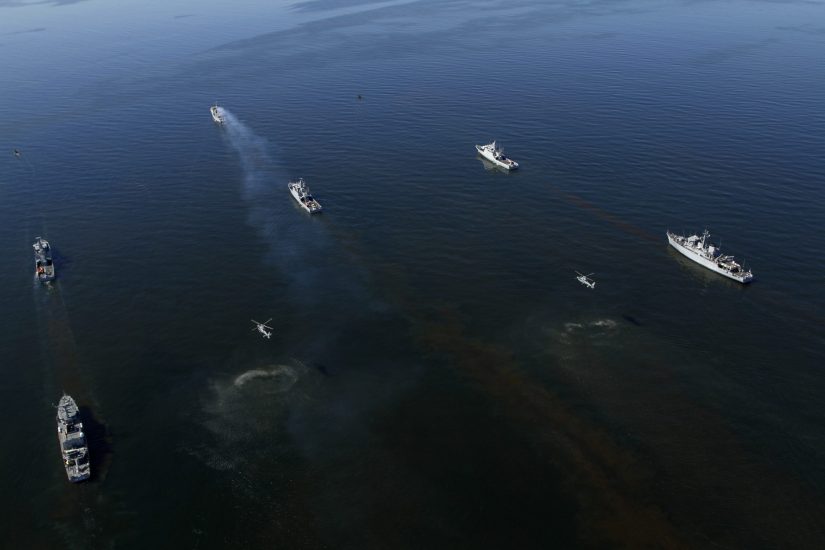
The European Union’s first project Ocean 2020 integrating all European military research enhancing security in the Mediterranean and the Baltic Sea will be continued in 2020. The first phase of the project took place in the Mediterranean and next year it will be implemented in the Baltic Sea. This project involves the Naval Force of the Lithuanian Armed Forces and the Baltic Institute of Advanced Technology (BPTI). In 2019, they conducted unique tests of communications technology in the Baltic Sea to facilitate the provision of real-time information on the marine environment from drones moving in the air, on the water and underneath it. It was part of this EU project Ocean 2020 intended for development of naval innovations.
The project Ocean 2020 is important not only technologically but also strategically. During its course, innovations ensuring maritime safety throughout Europe are created. It is also the first such project for the Naval Forces of the Lithuanian Armed Forces, which recently face many challenges at sea, from search and rescue operations to the protection of the sea lanes leading to the port of Klaipeda. The unmanned aerial vehicles developed in this project will enable our vessels to respond more quickly to what is happening in the marine environment, and the communications equipment will ensure real-time sharing of information with shore-based staffs,” says Lieutenant Commander Remigijus Zabiela.
In the summer of the year 2020, testing of unmanned aircraft conducting various unmanned systems operations at sea is planned in the Baltic Sea. It will also employ lessons learned from demonstrations in the Mediterranean in 2019. Under the leadership of the Italian Navy in the Mediterranean Sea, a demonstration was carried out to show the integration of different unmanned systems in naval vessels and the ability of these systems to transmit the required data for situational analysis.
A team of officers has been assigned for the project Ocean 2020 by the Lithuanian Naval Forces to assist the European Union scientific community in developing unmanned technologies and provide advice on operational issues. Also, Naval Forces provided the patrol vessel P11 “Žemaitis” with tactical task management system, which includes project equipment – unmanned aerial vehicle launch console and required communication equipment. The team of the Baltic Institute of Advanced Technology is also developing augmented reality solutions for unmanned aircraft operators, which are planned to be implemented in the project Ocean 2020 as well.
Augmented and virtual reality technologies will be used for the first time to monitor and control the maritime environment while implementing the project Ocean 2020 (Open Partnership for Better Awareness on the Maritime Situation in Europe). It is hoped that this will lead to a significant improvement in the conducting of operations, more efficient use of resources and real-time management of accurate information and intelligence.
In the course of the project involving partners from 15 EU countries, discussions have been carried out within individual groups regarding innovations to be made to ensure European maritime safety and setting the parameters for future systems. The system managers themselves were employed to select the design of the technologies in order to ensure not only the technical novelty of the solutions but also the needs of the end users of the systems.
Ocean 2020 is one of the first projects funded under the European Union Preparatory Action for Defense Research (European Defense Fund Testing Phase). Since 2018, the project has been implemented by a consortium of 42 partners from 15 European countries. The Lithuanian representatives are the Naval Forces of the Lithuanian Armed Forces and the Baltic Institute of Advanced Technology.
More about the project Ocean 2020 at https://ocean2020.eu/


