


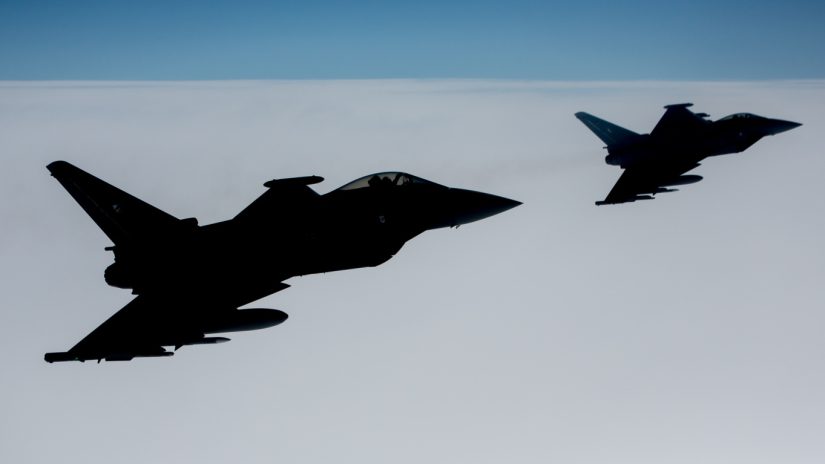
On May 13–19 NATO fighter aircraft conducting the NATO Air Policing Mission in the Baltic states were scrambled six times to identify and escort military aircraft of the Russian Federation in international airspace over the Baltic Sea.
On May 13 NATO fighter aircraft intercepted one AN-26 flying from mainland Russia to Kaliningrad with its onboard transponder off, maintaining radio communication with the regional air traffic control centre, according to a pre-filed flight plan.
On May 14 NATO fighter aircraft intercepted two SU-27s flying from Kaliningrad to meet an IL-22 and then going back. Neither of the two used their onboard transponders, radio communication was not kept, no flight plans.
On May 14 NATO air policing aircraft intercepted one IL-22 and two SU-27s flying from mainland Russia to Kaliningrad. After having made through half of the distance, the SU-27s turned around and flew back to mainland Russia. The IL-22 had its onboard transponder on, kept radio contact with the regional air traffic control centre , had flight plan. The two SU-27 did not use their onboard transponders, did not maintain radio communication, and did not have flight plans.
On May 15 NATO fighters intercepted two IL-22 and two SU-27 aircraft flying from Kaliningrad to mainland Russia. The SU-27s turned back after flying half the way and returned. The IL-22s had their onboard transponders on, maintained radio communication, and had the flight plans. Neither of the SU-27s had their onboard transponders on, did not maintain radio communication, and did not have the flight plans.
On May 16 NATO fighter aircraft intercepted one TU-134 flying from mainland Russia to Kaliningrad with its onboard transponder on, according to a pre-filed flight plan, without maintaining the radio communication.
On May 17 NATO fighter aircraft intercepted one TU-134 flying from Kaliningrad to mainland Russia with its onboard transponder on, without the flight plan, maintaining radio communication with the regional air traffic control centre.
Related photo, credit: Filip Modrzejewski


