


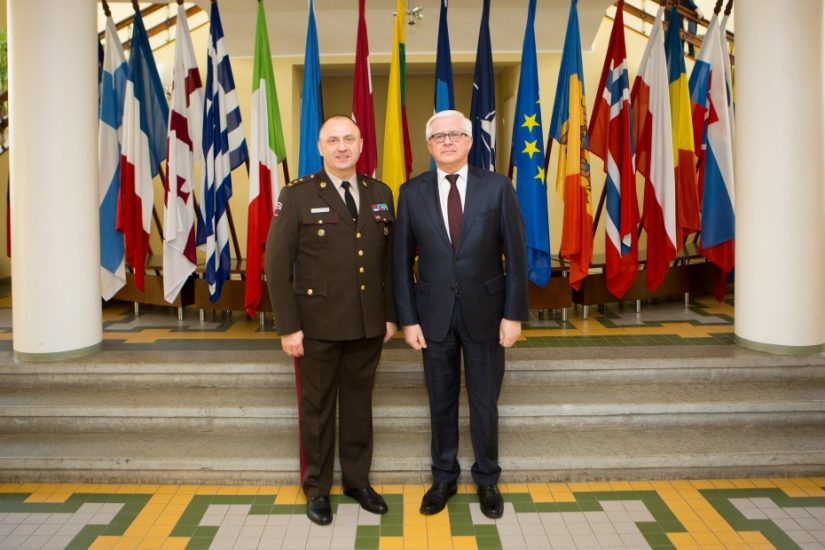
“The Baltic Defence College is one of the best recognised international military training institutions in the region. Its alumni are security and defence leaders of today who shape and implement directions of security policy to our countries and the entire NATO Alliance,” Vice Minister of National Defence Vytautas Umbrasas said at the commemorative events marking the 20th anniversary of the College based in Tartu, Estonia, on February 22.
A book about the activities of the institution, The History of the Baltic Defence College, was presented at the commemoration and a discussion involving leadership of the College and representatives from the Defence Ministries of the three Baltic states was held. V. Umbrasas stressed at the panel on the activity of the Baltic Defence College ad its benefit from Lithuania’s perspective he was sure that military education was vital and useful as it gave intellectual foundation for the fight against modern day military challenges. “Most importantly, it helps raising new generation leaders that who will be responsible e for this work. And our job is to look for opportunities to help them become such leaders,” Vice Minister said.
About the Baltic Defence College (BALTDEFCOL)
The Baltic Defence College is a joint Lithuanian, Latvian and Estonian education institution for operational and strategic level officers and civilian personnel studies.
The agreement of establishing the BALTDEFCOL was signed by the three Baltic states’ Defence Ministers in 1998, the College was inaugurated on 25 February 1999, and the first 32 students from 8 countries began studies at the College in August 1999.
The Baltic Defence College is a joint project of the three Baltic states established with assistance of NATO allies. It is recognised in many NATO countries which is reflected by officers from other countries studying along with Baltic students. Also, Lithuania provides funding for the studies of Georgian, Ukrainian and Moldovan students at the BALTDEFCOL.
The BALTDEFCOL delivers a five-month Higher Command Studies Course training officers and civilian personnel to initiate, lead, and implement strategic reforms in their countries, to be able to respond adequately to the changing security environment. The Joint Command and General Staff Course trains officers for tactical-level positions of command and work in international staffs for 11 months. The Civil Servants Course takes 3 months and provides skills and knowledge to civilian personnel for developing and implementing national security and defence policy. The Senior Leaders Course equips general-level officers and corresponding civilian personnel with knowledge and skills necessary for top-level national and international responsibilities. Also, a course for sergeant majors is launched this year.
The current Commandant of the Baltic Defence College is Maj Gen Andis Dilans of the Latvian Armed Forces – he took over from Maj Gen Vitalijus Vaikšnoras of the Lithuanian Armed Forces who was in office from December 2012 to June 2016. In 2004-2007 the College was supervised by Brig Gen Algis Vaičeliūnas of the Lithuanian Armed Forces. The BALTDEFCOL Commandants are assigned on a rotational basis by the three Baltic states.
Most of the commanders of Lithuanian Armed Forces units graduated from the Baltic Defence College.
Photo credits: baltdefcol.org


