


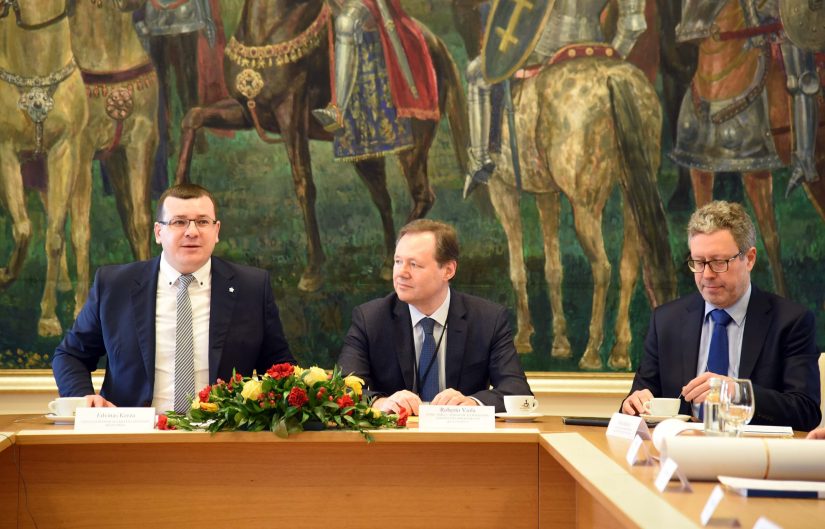
On February 19 the Cyber Security Council met at the Ministry of National Defence with high representatives of the European Commission in attendance. The first meeting this year addressed European Union and Lithuanian cyber security initiatives and issues and cyber challenges Lithuanian websites faced.
Director General of DG CONNECT (Directorate General of Communication, Networks, Content and Technology) of the European Commission Roberto Viola briefed participants of the meeting on key EC priorities in cyber security area. The guest reviewed the results of implementing the EU NIS Directive in member states and presented the fundamental objectives of the Cybersecurity Act – to develop a European cyber security agency and a cyber-security certification system at EU level.
R. Viola also presented the Digital Europe Programme proposed by the European Commission for 2021 – 2027 which would entail approx. EUR 2 billion financing for cyber security in Europe. The European Commission also initiates establishment of the European Cybersecurity Industrial, Technology and Research Centre of Excellence.
The EC official also spoke of the measures EU member states can take to ensure free and fair elections in 2019. In his turn, Director of the National Cyber Security Centre under the Ministry of National Defence Rytis Rainys presented the Centre’s efforts to ensure cyber security during the elections in Lithuania.
“The National Cyber Security Centre and other institutions concerning the exercise of elections are throwing all their efforts into ensuring cyber security of the elections process, identified risks are managed and identified threats are prevented according to an approved plan,” R. Rainys said.
Head of the Internet Media Association Aistė Žilinskienė presented to members of the Cyber Security Council the cyber security challenges that news portals are faced with. According to A. Žilinskienė, DDoS attacks are not the biggest problem anymore like it used to be – now its hackers changing contents of the information on a website, which is hard to notice, or automatically generated comments published under relevant articles, especially if they are on national security.
Members of the Cyber Security Council, among which there are scientists and practising specialists of cyber security, discussed the measures internet news websites could take in order to overcome the cyber security challenges they faced that were so specific. Members of the Council who spoke on the topic stressed that IT means were not enough to fight malicious actors – legislation regulating public information has to be reviewed.
Chairman of the Cyber Security Council Vice Minister of National Defence Edvinas Kerza proposed holding a separate session of the Council for addressing internet media issues, which could deliver specific proposals and a coherent action plan to implement the proposals.
Vice Minister E. Kerza presented to the Council the Amendment to the Law on Management of State Information Resources drafted on the initiative of the Ministry of National Defence and adopted by the Seimas in late 2018. The Amendment stipulates that state and municipal institutions and agencies which are a part of implementation of state mobilisation tasks for ensuring critical functions of the state have an obligation to use a secure state data transfer network (the Secure Network).
“The Secure Network will be separated from public communication networks, therefore it will stay functional in case of a crisis or war. Implementation of the project will allow to respond to cyber incidents more quickly and effectively and also save financial resources of the state dedicated for cyber security,” E. Kerza stressed. According to Vice Minister, centralisation of cyber security will provide conditions to apply measures of collective defence more effectively.
Other pressing issues – such as, use of Huawei technologies in the sectors of economy of strategic importance to national security, identification of critical information infrastructure according to updated methodology, and the need to develop cooperation on cyber security – were also touched upon at the meeting of the Cyber Security Council.
Photo credits: Giedrė Maksimovicz (MoD)


