


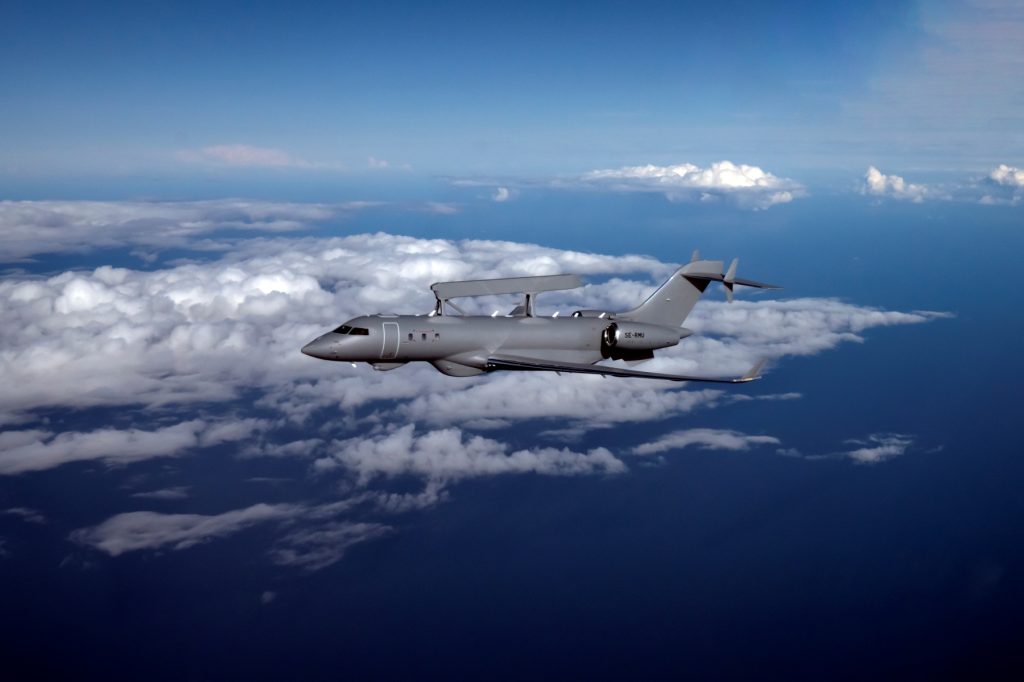
Lithuania, alongside 10 other Allies, signs on to one of the Alliance’s most pivotal surveillance and early warning capability upgrade projects. The initiative involves the planned procurement of up to 10 Saab GlobalEye aircraft equipped with the Initial Alliance Future Surveillance and Control capability.”
The new aircraft will support and eventually replace the legacy fleet of NATO’s E-3A Airborne Warning and Control System (AWACS) aircraft. Nicknamed “the eye in the sky” of NATO for decades, the system will give way to the GlobalEye for the coming decades bringing in significantly broader capabilities.
“Approximately 20% of AWACS capacity was dedicated to surveillance in the Baltic region last year, whereby strengthening the Alliance’s intelligence, surveillance, and command capability directly increases the security of our region and visibility on the eastern NATO border. This project also demonstrates that the Allies are not just consumers of the collective NATO capabilities but also their contributors. The European Allies and Canada are taking an increasingly more significant share of the burden in collective defence,” said Minister of National Defence Robertas Kaunas.
The GlobalEye is a system tested in real-life operations that detects, tracks and identifies complex threats, including drone swarms, ballistic and cruise missiles. The aircraft are capable of high-altitude surveillance of airspace and surface picture, or function as a communications relay station and airspace command and control (C2) centre.
Lithuania sees the capability as strategic. In the event of crisis of conflict, the system would enable earlier detection of threats, more precision in situational awareness, and more efficient coordination of Allied action in the region.
The procurement is also joined by Belgium, Denmark, Germany, Luxembourg, the Netherlands, Norway, Romania, Sweden, Canada and Latvia, other European Allies are also considering.
The general value of the project will stand at approx. EUR 5 billion. The Alliance is expected to receive the first equipment in 2030–2031. By nature, the project is transatlantic, led by the European Allies and Canada, with a large prospective input from the U.S. industry. The agreement is seen as one of the most significant results of the implementation of the commitments made in the NATO Summit in The Hague.


