


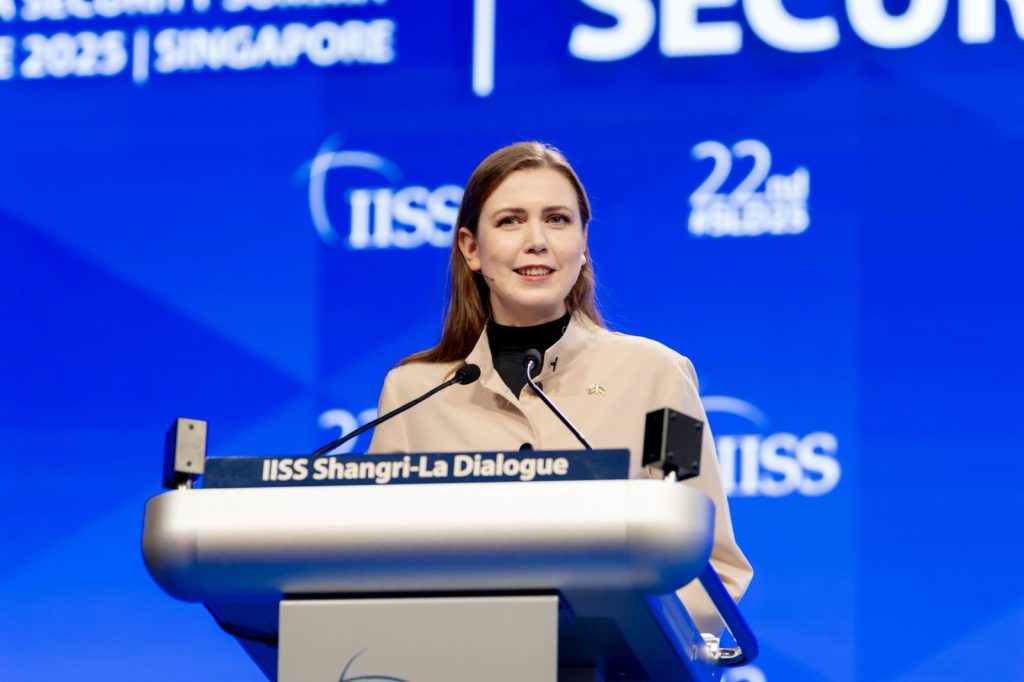
At Asia’s premier high-level defence and security forum, the Shangri-La Dialogue held in Singapore, Lithuania’s Minister of National Defence Dovilė Šakalienė introduced Lithuania’s Strategy for Security and Defence Engagement in the Indo-Pacific Region developed by the Lithuanian Ministry of National Defence.
Lithuania is among the first European Union countries to develop such a strategic document. Approved in May 2025, the strategy focuses on enhancing political dialogue in defence, military cooperation including joint exercises and training, intelligence sharing, cyber security collaboration, countering hybrid threats, development of joint defence industry projects, and other areas to maximize Lithuania’s strategic impact.
Minister D. Šakalienė emphasized the growing interconnectedness of security challenges across Europe and the Indo-Pacific region: “The rapidly evolving global security environment shows that the challenges facing both Europe and the Indo-Pacific region are directly linked. For example, Japan and Lithuania share borders with Russia and face similar threats. Due to current and potential aggressive actions by Russia and China in both regions, there is an increased need for cooperation with the IP4 countries – from cybersecurity and joint exercises to defense industry collaboration and sharing best practices in collective defense and combating disinformation. Key objectives also include establishing regular working-level formats, expanding intelligence ties, and formalizing information-sharing agreements.”
The Lithuanian Ministry of National Defence aims to strengthen cooperation by expanding diplomatic defence representation, participating in key security initiatives, and advancing joint projects within the defence industry. While European security and threats from Russia remain priorities, Lithuania’s activities in the Indo-Pacific region – conducted bilaterally and through multilateral and U.S.-led efforts–directly enhance national security.
The strategy outlines Lithuania’s engagement will focus on areas where the country’s specialised capabilities may have the greatest impact. Efforts will be closely coordinated with EU, NATO, and U.S. initiatives, while building strategic partnerships that provide long-term security benefits for all parties.
“The growing cooperation between China, Russia, North Korea, and Iran demands even stronger alliance and partner cohesion from the Atlantic to the Pacific. We are already witnessing this authoritarian cooperation in action –North Korea’s weapons and forces in Ukraine, the strategic partnership between Russia, China, and North Korea, and cyber and hybrid attacks against European and Indo-Pacific nations. Therefore, the dominant narrative at the Shangri-La Dialogue –that close cooperation among the EU, U.S., and Indo-Pacific countries is essential – is a very positive development,” Minister Šakalienė underlined.
The full Lithuanian Strategy for Security and Defence Engagement in the Indo-Pacific Region, developed by the Lithuanian Ministry of Defence, is available here: Strategy of Security and Defence Engagement in the IP4
Photo credits: MoD


