


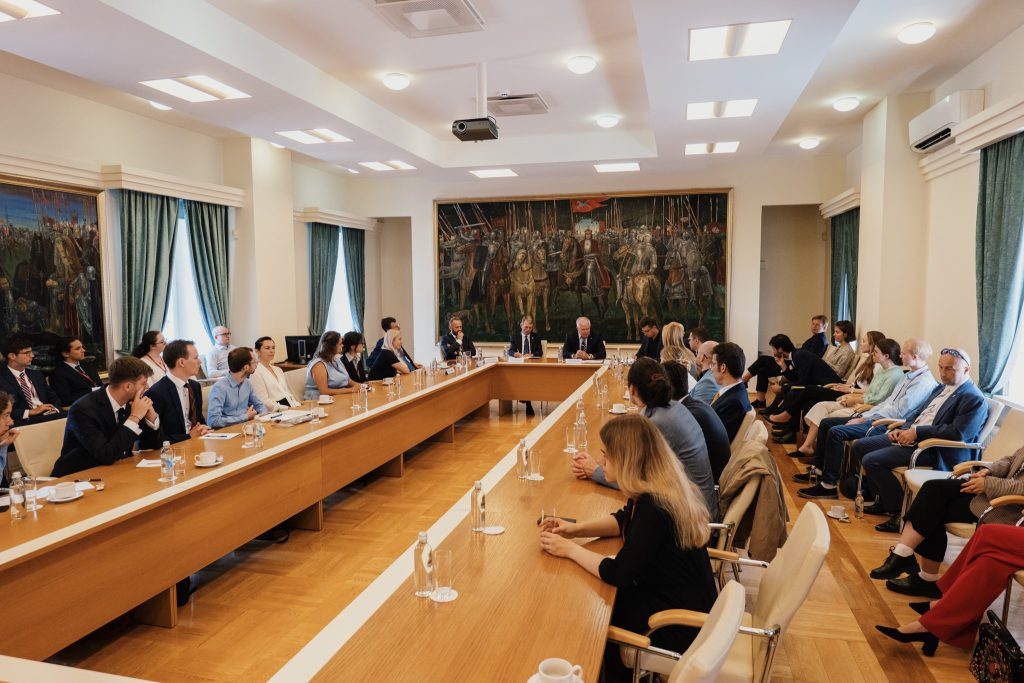
Students and scholars of the Centre for Geopolitics at Cambridge University were on a visit in Lithuania last week to discuss the British geopolitics in the Baltic states during their Summer School. The activity organised by the Faculty of history of Vilnius University concluded with a debate on security challenges facing the Baltic region at the Ministry of National Defence which was attended by minister of National Defence Dr. Arvydas Anušauskas, Ambassador of the United Kingdom to Lithuania HE Bryan Oley, Executive Director of the British Chamber of Commerce in Lithuania Rasa Ščiukinaitė, former Home Secretary of the United Kingdom Prof Charles Clarke, member of the academic communities of Vilnius and Cambridge Universities.
Russia is a recognized security threat
“When we talk about security challenges to the Baltic region we primarily mean Russia, the threats it presents currently and the aggression against Ukraine, which has changed and continues changing the geopolitical situation in the region. I think every European country is perceiving very similar threats and risks at the moment,” spoke Minister of National Defence Dr. Arvydas Anušauskas while also highlighting that NATO, too, named Russia as a threat to the whole Alliance and the Euro-Atlantic security.
The war in Ukraine, as it has changed and keeps changing the geopolitical situation in the region, is at the same time also shaping new cultural, political and economic relations among the countries. Executive Director of the British Chamber of Commerce in Lithuania said that despite a certain level of loss that Lithuania suffered as a result of the Russian aggression and limitations on export to China, it also opened new opportunities.
“We know from textbooks that war always costs. Of course, it has had a strong impact on commerce already. However, we are prepared to shoulder all economic costs because Europe stands united in this area too and ready to support this sector in the Baltic states as well,” Executive Director of the British Chamber of Commerce in Lithuania says.
According to her, it is necessary to remember that Lithuania was the first country to take the brave decision to become independent from Russian oil and gas and stands as a role-model for further European steps to become less dependent on Russian energy.
Ambassador of the United Kingdom HE Bryan Oley overviewed international relations calling Lithuania a brave country which was ready to stand by its beliefs no matter what. He praised excellent bilateral diplomatic and commercial relations between Lithuania and the United Kingdom that were becoming even stronger and wider-ranging recently. According to him, tense relations with China caused Lithuanian exports there to drop by over 75% in 2022 but Lithuania turned to forming new commercial ties in other countries, such as Taiwan. Exports from the UK to Lithuania and imports from Lithuania to the UK have grown over the past two years as well.
Rasa Ščiukinaitė supported Ambassador’s claim about the increasing export from Lithuania to the UK saying she could also see positive trends for further growth in the future too.
The UK will continue supporting Lithuania
Former Home Secretary of the United Kingdom and MP Charles Clarke underscored the importance of history for understanding the present geopolitical situation in the Baltic region. “Only awareness of past events and their course can help understand the present. Geopolitical challenges must be viewed through the prism of historical experience.” He also assured that despite the present political changes in his country, the United Kingdom would certainly continue supporting Lithuania in security area.
The discussion at the Ministry of National Defence the Republic of Lithuania has not only expanded the understating of the Baltic region and its security architecture for Cambridge students but also highlighted the importance of historical awareness and the academic community in solving geopolitical challenges of the present. Synthesis of the academic and the political field gives a multi-perspective view on today’s events, enables a smooth decision-taking, and cooperation among countries in a variety of formats. The Summer School organized by the Faculty of History of Vilnius University for students of the Cambridge University –future lawyers, politicians, public servants and diplomats has widened the horizon in terms of understanding the region and fortified international academic cooperation accordingly.
Information and photo credits: Vilnius University


