


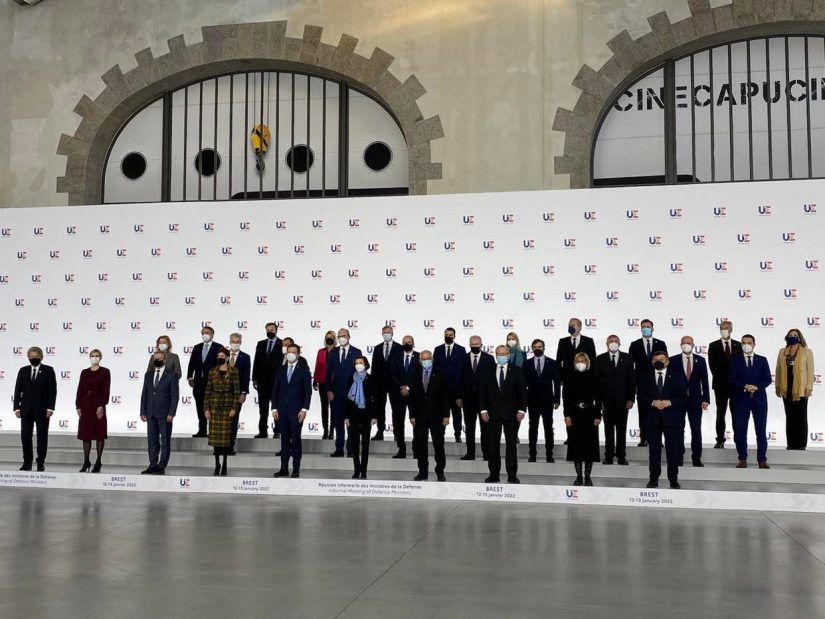
“The security of Europe cannot be seen separately from the security of Ukraine,” says Minister of National Defence Arvydas Anušauskas, in attendance at the informal European Union Defence Ministers meeting in France on January 12 – 13. The Ministers are convening in Brest on the decisions to be taken in the light of the deteriorating security situation in Europe, especially with regard to the situation by Ukraine’s borders.
The EU Defence Ministers are focusing on the EU assistance to Ukraine and the efforts to strengthen the efficiency of its military sector, ahead of the next Defence Ministerial in March where establishment of the EU Military Mission in Ukraine initiated by Lithuania will be decided on. According to Minister A. Anušauskas, such a mission will ensure the country receives specifically the kind of assistance it needs most at the moment.
“A EU advisory training mission would be a strong message of the EU solidarity with Ukraine and an opportunity to demonstrate the credibility of the EU security action,” said A. Anušauskas. Minister also attended the Bucharest Nine Defence Ministers meeting with Minister for the Armed Forces of France Florence Parly and met with Minister of National Defence of Greece Nikolaos Panagiotopoulos while in Brest.
EU Defence Ministers also had discussions with NATO Secretary General Jens Stoltenberg and United Nations Under-Secretary General Jean-Pierre Lacroix on the effect of private military companies, especially Russian, on the efficiency of the EU military missions and operations in both, Africa and eastern Ukraine (Donbas), while meeting at Brest. Ministers expressed a very strong encouragement for Mali to stop the collaboration with the Wagner Group, a Russian mercenary company.
“We cannot have a shared operational space with the Wagner Group. The Malian military transitional government has to understand it clearly,” said Minister A. Anušauskas.
Defence Ministers also held a joint working session with EU Foreign Ministers on the content of the EU Strategic Compass. According to A. Anušauskas, the document must identify the threats posed by Russia’s violations of the international law and a clearly provided EU commitment to an extended cooperation with NATO, U.S., and other NATO allies.


