


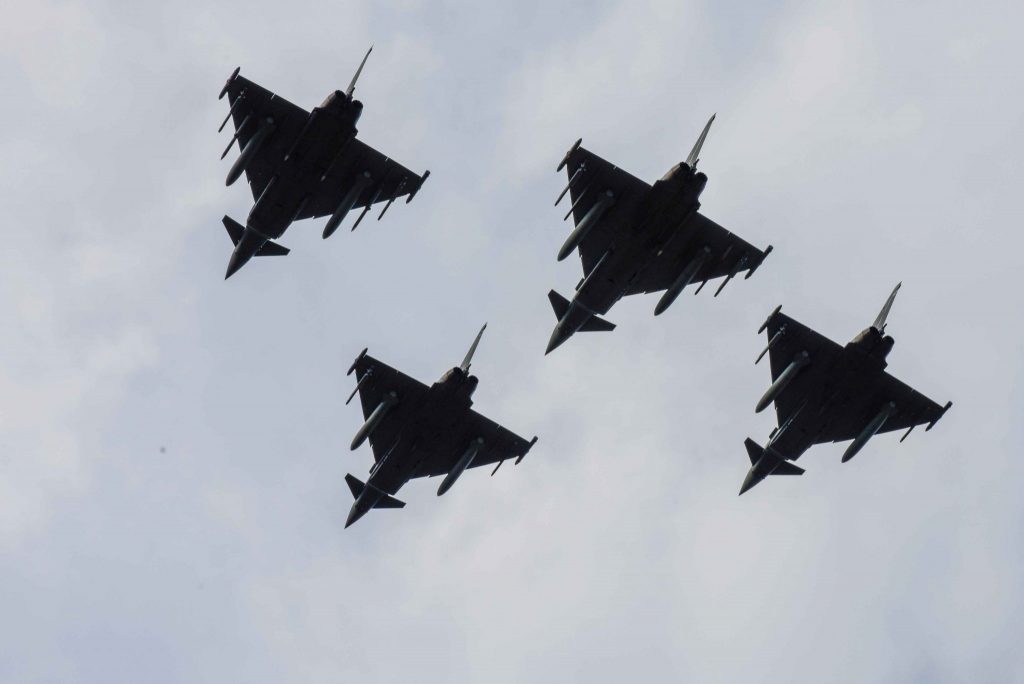
On June 1–7 the NATO Baltic Air Policing Detachment was alerted in response to international flight regulation violations seven times and patrolled the Estonian, Latvian and Lithuanian border with the Russian Federation and Belarus twice.
On June 1 NATO air policing fighter jets were alerted to identify and escort two SU30 flying from Kaliningrad and back via international airspace. Their onboard transponders were not switched on, no flight plans had been pre-filed and the crews were not maintaining radio communication with the regional air traffic control centre.
On June 2 NATO fighter aircraft were dispatched to patrol the Polish-Ukrainian border area.
On June 2 NATO fighter jets intercepted one SU35 which was flying through international airspace from Kaliningrad and back. Its onboard transponder was switched off, the crew had no flight plan and was not maintaining radio communication. Also, one IL-76 was identified on the same scramble, flying between mainland Russia and Kaliningrad via international airspace. Its onboard transponder was switched on, the crew was maintaining radio communication but had no flight plan. Also, one SU-24 and SU-34 were intercepted flying from mainland Russia to Kaliningrad via international airspace, with the onboard transponders off, no flight plans, not maintaining radio communication with the regional air traffic control centre. Other aircraft intercepted on the same occasion were an AN-30 flying between mainland Russia and Kaliningrad through international airspace, no onboard transponder, no flight plan, no radio communication, and one AN-12, flying from mainland Russia to Kaliningrad via international airspace with the onboard transponder switched on and maintaining radio communication, but without the pre-filed flight plan.
On June 3 the NATO fighter aircraft safeguarding the Baltic skies were dispatched to patrol the eastern border area in Latvia and Estonia.
On June 3 NATO fighter aircraft were scrambled in response to two SU30 flying from and to Kaliningrad with their onboard transponders switched off, no flight plans, and not maintaining radio communication.
On June 4 NATO fighter jets were scrambled in response to a potentially airborne SU34 flying from and bound to Kaliningrad, without the onboard transponder, without the flight plan, and not maintaining radio communication. Eventually, the object was not identified.
On June 4 NATO fighter jets intercepted one IL-20 flying from mainland Russia to Kaliningrad. Its onboard transponder was switched off, the crew had no flight plan and was not maintaining radio communication. During the same scramble, the fighter crews received order to also intercept a potential SU-30SM flying from and to Kaliningrad via international airspace, without the flight plan, not maintaining radio communication and not using the onboard transponder, DUE to the meteorological conditions, the target identification failed.
On June 4 the NATO air policing capability was sent to identify an airborne target over Estonia. The mission was not completed.
On June 5 NATO fighter jets were alerted to identify and escort one TU-214PU flying through international airspace from mainland Russia to Kaliningrad. Its onboard transponder was switched on, the crew had a pre-filed flight plan and maintained radio communication with the regional air traffic control centre.
On June 5 aircraft of the NATO Air Policing Detachment were dispatched to intercept one IL-78 flying from the mainland Russia to Kaliningrad with its onboard transponder switched on, without the flight plan, but maintain radio communication with the regional air traffic control centre. NATO fighter jets also intercepted one AN-72 flying through international airspace from mainland Russia to Kaliningrad, without the flight plan, but with its onboard transponder switched on and maintaining radio communication with the regional air traffic control. On the same scramble, one IL-76 was also identified and escorted. The aircraft was flying from Kaliningrad to mainland Russia, without the flight plan, with its onboard transponder switched on, and maintaining radio communication.


