


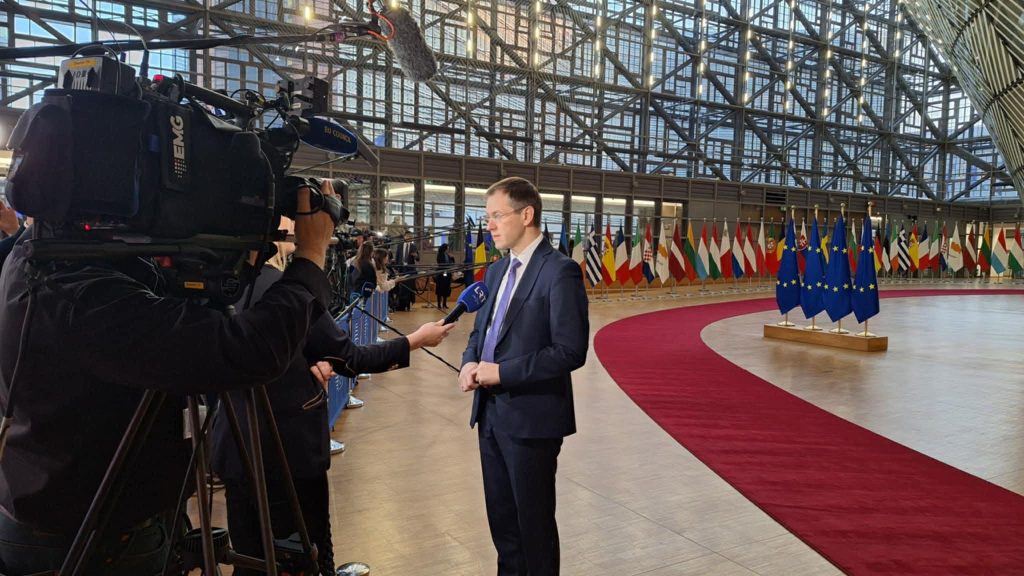
Vice Minister of National Defence Karolis Aleksa took part in the European Union Foreign Affairs Council in Defence Session in Brussels. EU Defence Ministers discussed the 2030 EU Defence Readiness Plan and military EU’s support to Ukraine. The session was attended by Minister of Defence of Ukraine Denys Shmyhal and NATO Deputy Secretary General Radmila Shekerinska.
In the opening part of the meeting Vice Minister K. Aleksa expressed deepest sympathies to family, colleagues and the society of Belgium about the Belgian soldier who sustained terminal injuries while on training in Lithuania and thanked the Belgians for the contribution to the security of Lithuania and the whole region.
K. Aleksa pointed out to the EU colleagues the hybrid threats Belarus posed to Lithuania. “The smuggling balloons repeatedly sent to Lithuania from the territory of Belarus violate our airspace and disrupt safe aviation. If we wish to face the challenge successfully, we need to develop new technologies, so we invite all EU member states to test their innovations in Lithuania. We also encourage the EU to demonstrate solidarity and denounce the malicious Belarusian activity,” said K. Aleksa. Vice Minister underscored that the growing number of hybrid incidents underlined the necessity to further increase the sanctions to the Belarusian regime.
Vice Minister also introduced Lithuania’s plans to strengthen national countermobility and air defence capabilities for prevention of threats posed by drones and other aerial objects. Our defence budget will exceed 5% of GDP next year but we cannot safeguard the border alone: we need more engagement from the European Union. Two major initiatives, Eastern Sentry and European Drone Defence Initiative (EDDI) need to be put into practice immediately,” Vice Minister said.
The session also focussed substantially on military support to Ukraine. Vice Minister underlined the necessity to step military assistance to Ukraine, strengthen the EU members states’ cooperation with Ukraine’s defence industry, and include Ukraine in SAFE and EDIP. He also noted the importance of Ukraine’s EU membership by 2030 and reparations loan to Ukraine backed by the frozen russian assets. Said assistance must be used for Ukraine’s priority needs.


