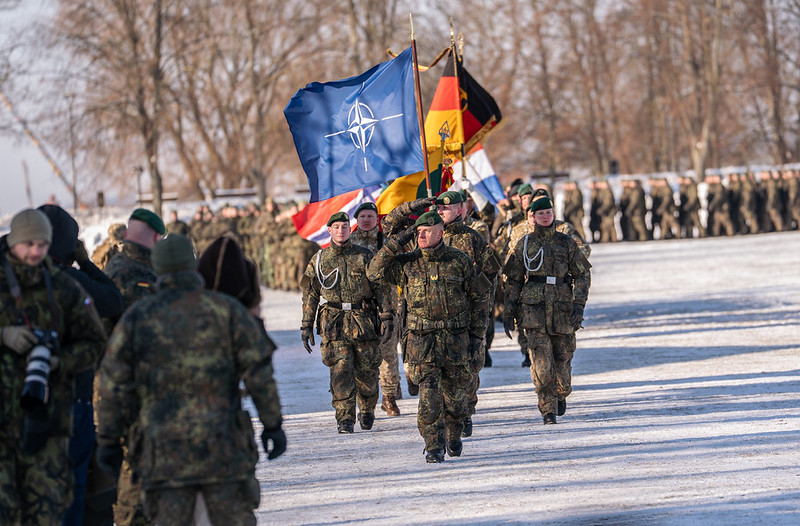
The Rūdninkai military town will become the primary service location for the future German Brigade. This is the most ambitious military infrastructure project ever developed in the history of independent Lithuania. On 19 August 2024, a time capsule was placed at the Rūdninkai training area, marking the establishment of the Rūdninkai military town.
It is planned that the military town will occupy around 190 hectares of the Rūdninkai training area. It will accommodate both German and Lithuanian armed forces, a tent city and an outdoor camp. In the upcoming years there will be constructed:
- approximately 91,000 sq. m. of residential buildings
- around 84,000 sq. m. of administrative buildings, including administrative offices, company barracks, training classrooms, rest areas and more
- around 7,000 sq. m. of sports facilities
- around 80,000 sq. m. of technical buildings including warehouses, garages, a fuelling station, car wash stations and repair workshops
- around 300,000 sq. m. of paved areas in the compound, including internal roads, parade grounds, technical park zones and parking areas
Due to its exceptional size, the military town of Rūdnininkai is being developed in phases. During the first phase, administrative buildings, military vehicle maintenance and storage infrastructure (warehouses, parking areas, repair workshops, garages for vehicles), a guardhouse, barracks, a canteen and other facilities will be constructed. The first phase will cover almost 56,000 sq. m. of land, with construction work carried out by the Lithuanian company Eikos statyba. Works on Phase I of the Rūdninkai military town are progressing ahead of schedule; the completion of this phase is projected for late 2026, while the contract deadline is August 2027.
In the second phase, the remaining infrastructure of the military town will be developed, covering an area of 170 hectares. This phase will be implemented through a public–private partnership (PPP) model and will include not only design and construction works, but also the maintenance of newly created infrastructure, engineering networks and systems. The project’s implementation period is set for 15 years, with 2.5 years dedicated to design and construction (development) and 12.5 years for the maintenance of the town and service provision. Contracts have been signed with the companies UAB Rudina, UAB VPSP B, and UAB VPSP C for the implementation of the Phase II construction project of the military town at the Rūdninkai military training area.
In accordance with the requirements agreed with the German Ministry of Defence, the development of the Rūdninkai military town has been prioritised into two phases in order to host a portion of the German brigade troops earlier, without waiting for the completion of the entire project. Critical infrastructure at the Rūdninkai training area is planned to be completed in 2027, which will enable the German brigade in Lithuania to achieve Full Operational Capability on schedule.
All military infrastructure developed in the Rūdninkai training area will be owned by the Lithuanian state, and the Lithuanian Armed Forces will manage, use and dispose of it under a trust-based system.
Projects are also being developed in Rukla to meet the needs of the German Brigade and allied forces:
- The strategic ‘Aukštutinė Neries terasa’ (Upper Neris Terrace) infrastructure project is under construction in Rukla – a modern military town designed for 1,000 troops of the ‘Geležinis Vilkas’ (Iron Wolf) Infantry Brigade and 2,000 NATO personnel. The complex will comprise administrative buildings, residential facilities, logistical support infrastructure, sports and training areas, a medical aid post, a dining facility, leisure zones, and all necessary engineering infrastructure. Construction will run until 2028, with a total budget of approximately €300 million. Lithuania is sharing the costs equally with Germany.
- In 2025, the ‘Žemutinė Neries terasa’ (Lower Neris Terrace) was completed in Rukla – a Germany-funded permanent logistical support base dedicated to the storage and maintenance of Allied equipment. It features repair and maintenance workshops, warehouses, a vehicle wash facility, a refuelling station, and all equipment essential for technical readiness, ensuring that NATO forces deployed to Lithuania remain in a high state of readiness at all times.
- Ammunition storage facilities are being constructed.
Logistical support infrastructure for the German Brigade is also being developed in other locations in Lithuania.